
“Al-Mawqif Al-Adabi” magazine reprints the book “The Story of the Land in Syria” by Munir Al-Sharif
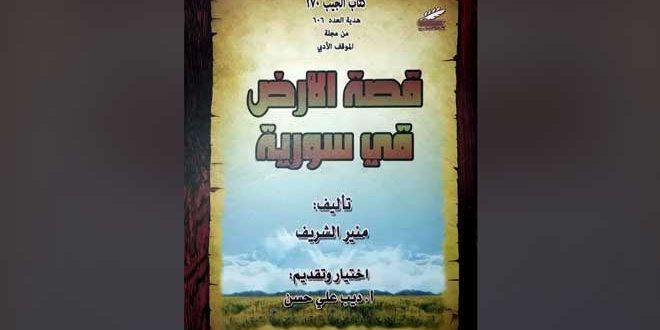
The book “The Story of the Land in Syria” is one of the first publications published by the Ministry of Culture in Syria shortly after its establishment in 1961. Its author, researcher Munir Al-Sharif, presented historical stages of the agricultural and economic methods of dealing with the land through a series of civilizations that Syria witnessed more than two thousand years ago.
As a reminder of this book and the information and documents it contained on which Syrian and Arab scholars relied, the monthly Literary Position “Al-Mawqif Al-Adabi” magazine issued by the Arab Writers Union reprinted it recently as part of the Pocket Book series.
Researcher Deeb Ali Hassan, who presented the book, finds that the real value of this work is what it reveals about the amazing progress in dealing with the land that the Syrians have known since ancient times when they established their cities and their civilizations on the shores of the Euphrates and the Tigris and reclaimed the lands as in Ugarit, spreading knowledge and science everywhere. So, that is why Syria is described as the icon of the earth and the source of civilizations.
Hassan noted that the book presents the injustice that befell the Syrians from the invaders of Greece, Romans and Byzantines. It also dealt with the struggle of the Syrians to preserve the land and shows with facts, figures and evidence the corruption afflicted by invaders who worked to exploit Syrian land and when they failed they destroyed the stones and burnt the trees.
The book also sheds light on the Arab-Islamic era, and on the huge amount of taxes that the Ottoman occupation burdened Syrian farmers and landowners with.
The book casts light on the French occupation and its policy of exploiting the lands in Syria in the most horrific ways.
The book concludes its chapters by talking about the owners of agricultural lands in Syria after the Independence, most of whom were feudal lords, and about the agricultural reform law that was issued in 1959 and determined the ownership of these lands.
The editor-in-chief of the Literary Position magazine Falak Hussariya pointed out that the book embodies the ancient history of Syria and sheds light on the adherence of the people of Syria to their land and not abandoning an inch of soil from it.
Inas Abdukareem