
Al-Jaafari: terrorist war, occupation, and coercive measures cause catastrophic repercussions in Syria
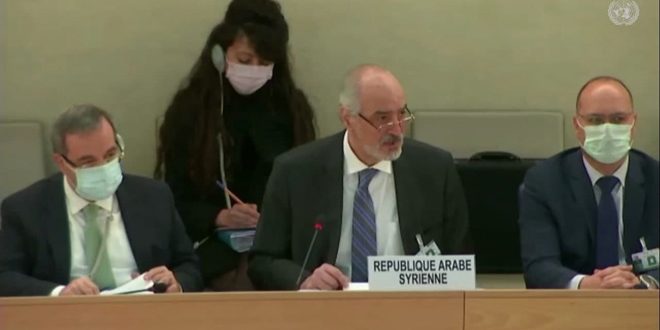
Deputy Minister of Foreign Affairs and Expatriates, Dr. Bashar al-Jaafari affirmed that the terrorist war against Syria, the foreign occupation of part of its lands, and the continuation of external support for terrorism have caused catastrophic repercussions on the human rights situation in it. The Western countries, led by the United States and the European Union, imposed unilateral coercive economic measures targeting the Syrian citizen and his right to lead a decent life.
Al-Jaafari, head of the national committee concerned with preparing the national report for the third session of the universal periodic review mechanism, noted in a statement today before the Human Rights Council that Syria presents to the Council its third national report on time, despite the challenges it faces. Syria is keen to implement its international obligations out of its belief in international cooperation based on the UN Charter.
Al-Jaafari indicated that the national report was prepared with the participation of various government sectors, where the members of the National Committee followed a virtual workshop for training in its preparation organized by the United Nations High Commissioner for Human Rights at the request of the Syrian government in two stages.
Two workshops were also held with members of the People’s Assembly on the one hand and with representatives of civil society and stakeholders on the other hand, within the framework of consultation and preparation for this report.
He indicated that the report focused on providing information related to developments in the Syria in the field of promoting and protecting human rights during the period under review. The report also shed light on the efforts made by the state and the national programs and plans aimed at strengthening the protection of human rights and related initiatives, despite the difficult conditions that Syria is still going through as a result of the continuation of the terrorist war and the unilateral coercive measures imposed on it.
Al-Jaafari pointed out that although most of the recommendations addressed to Syria in that round were politically motivated and not related to human rights, Syria committed itself to working on implementing the recommendations accepted in the second round of the mechanism.
Al-Jaafari said that with the passage of many years since the beginning of the crisis in Syria, it is necessary to recall that, since 2011, Syria has been facing a systematic terrorist war and foreign occupation of part of its territory, with continued external support for terrorist groups. These grave challenges had catastrophic repercussions on the human rights situation in Syria, and the imposition of unilateral coercive measures by Western countries, led by the United States and the European Union,increased its severity and exacerbation. These strict and expanded measures, despite the repercussions of the Covid 19 pandemic, turned into economic terrorism represented by imposing a comprehensive siege targeting the Syrian citizen’s right to life, decent living, health, education and development in all its forms. The Turkish occupation’s use of water as a weapon and a tool for blackmail and political pressure, amounts to a crime against humanity. These measures have strongly limited the state’s capabilities to carry out the tasks entrusted to it in an optimal manner to protect its citizens. Despite these grave challenges, the state assumed its responsibilities and duty to preserve its sovereignty, liberate its lands and combat terrorist groups and foreign occupation and to preserve the security and lives of its citizens from the beginning of the crisis.
The Deputy Minister of Foreign Affairs and Expatriates clarified that the national report highlights the work of the legislative, judicial and executive authorities and the state’s efforts to rebuild and protect the rights of the Syrian citizen at the national level within the available capabilities, to achieve the goals of the 2030 Agenda for Sustainable Development, to address the COVID-19 pandemic, and to secure an environment that enables Syrian refugees to return safely and voluntarily to their homeland.
Al-Jaafari stressed that, within the framework of working to alleviate the effects of the crisis on its citizens, Syria cooperated with international governmental and non-governmental organizations. It allowed about44 international NGOs concerned with humanitarian affairs to work on its territory and facilitated their work with the aim of supporting the state’s efforts to contribute to mitigating the negative effects of the crisis and unilateral coercive measures and to meet the basic needs of the Syrians.
Al-Jaafari pointed out that Syria has been cooperating since the beginning of the crisis and is still cooperating with the United Nations bodies and mechanisms in accordance with the principles established by General Assembly Resolution 46/182, in order to mitigate the effects of the crisis on the affected Syrians, the needy and the returnees.
Al-Jaafari pointed out that due to the focus of many of the recommendations on the issue of cooperation with United Nations mechanisms, it is necessary to note that Syria cooperates with these mechanisms on the basis of the principle of impartiality, non-politicization, respect for the mandate and the provisions of the relevant Human Rights Council Resolution No. 5/2 /.
Regarding recommendations on dialogue and cooperation with the international community within the framework of the political process, Al-Jaafari reiterated Syria’s commitment to this process and its references in terms of being a path led and owned by the Syrians themselves without any external interference or preconditions. Accordingly, Syria participated in the Geneva, Astana and Sochi meetings, where this participation culminated with the formation of the Constitutional Discussion Committee, which began its work in Geneva in 2019 and has held since then six rounds of meetings. With regard to recommendations on advocating adherence to international law and human rights law, Syria considers international peace and security a major goal and a strategic choice, and works to achieve both in accordance with international law and the values of truth and justice.
Al-Jaafari asserted that Syria, in compliance with international law and the UN Charter, has taken measures to protect its citizens from violations committed by terrorist groups and has regained large parts of the areas controlled by these groups and restored security, stability and the rule of law to them, which contributed to providing protection and restoring basic services to citizens in those areas. Syria, as part in most of the international humanitarian law conventions, foremost of which are the Geneva Conventions, has formed a national committee for international humanitarian law whose mission is to sponsor and coordinate national action for integrated awareness of international humanitarian law and harmonize national legislation.
The Deputy Minister of Foreign Affairs and Expatriates affirmed that Syria is committed to the rules of international human rights law and to submitting its periodic reports within the available conditions to the treaty bodies to which it is a party. It formed national committees to follow up on the implementation of the concluding observations issued by these bodies.
Regarding the recommendations on ensuring humanitarian aid, and medical evacuation, Al-Jaafari stated that Syria, based on its constitutional duty and in line with the principles of international laws and relevant resolutions, and in accordance with the principles of humanitarian action, has facilitated humanitarian access to all its areas across the lines and without discrimination, including difficult-to-reach or besieged areas by terrorist groups. This governmental effort included the assistance provided by international organizations concerned with depoliticized humanitarian work in coordination with the Syrian Arab Red Crescent and NGOs, provided that safety and security of these convoys are ensured and that aid, which included food and non-food items, medical materials, water and others in need, is ensured and that terrorist groups are preventedfrom taking over them. Syria’s approval of declaring “humanitarian truces” and securing humanitarian corridors for this purpose are indicators in this framework, and the examples are countless.
Al-Jaafari said: This report cannot be completed without casting light on the painful situation of the occupied Syrian Golan with regard to human rights issues. The situation in it sums up in its severity and inhumanity the entire suffering of our people, as the Israeli occupation of the Golan violate Geneva Conventions and the principles of International law, relevant United Nations resolutions and Human Rights Council resolutions, foremost of which is Resolution 497 of 1981.
Al-Jaafari referred to the disregard of all UN institutions, bodies and agencies to the alliance of the Israeli occupation authorities with international terrorism and the sponsors of this terrorism.
The Deputy Minister of Foreign Affairs and Expatriates stressed that Israel’s violation, the occupying power, of the references of international law, international humanitarian law, human rights law and United Nations resolutions related to the occupied Syrian Golan is a double violation that inevitably calls for Israel’s accountability. This requiresthe expulsion of “Israel” from the international organization and obligating it to end the Israeli occupation of the occupied Syrian Golan.
In response to the statements of representatives of some countries, Al-Jaafarisaid: The volume of accusations and allegations made by some delegations in the course of their questions involve a lot of prejudice that does not take into account the complexities of the situation as a whole. He noted that most of the attendance here don’t know that there are nine international investigation mechanisms working around the clock to offend the Syrian government.Everyone knows that most of the sources from which these mechanisms derive their information, which are called “open sources,” lack credibility and are infiltrated by the intelligence services of countries that sponsor terrorism.
Inas Abdulkareem