
ACSAD, Arab Organization for Agricultural Development discuss cooperation, implementation of development projects in Syria
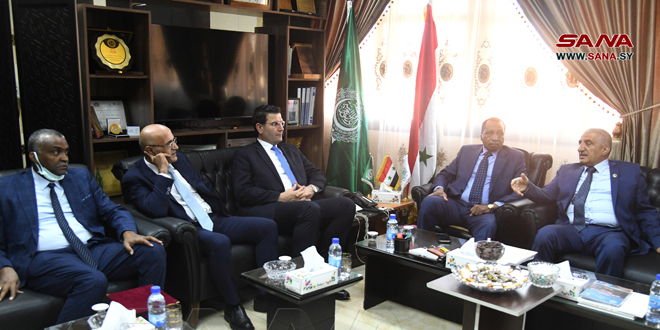
On August 7th, the Director General of the Arab Center for the Studies of Arid Zones and Dry Lands (ACSAD), Dr. Nasr Al-Din Al-Obeid met with Dr. Ibrahim Al-Dakhiri, Director General of the Arab Organization for Agricultural Development.
The two sides discussed cooperation relations and ways of developing and strengthening them in various fields, and the implementation of development projects in Syria.
During the meeting held at ACSAD’s headquarters in the countryside of Damascus, Dr. Al-Obaid considered that the visit of this delegation comes in implementation of the decisions of the Higher Coordination Committee for Joint Arab Action and for cooperation and networking between specialized organizations, Arab labor organizations and Arab countries.
Al-Obaid praised the bilateral cooperation between ACSAD and the Arab countries in agricultural development programs, which resulted in many successful projects.
Al-Obaid pointed out that after the Arab summit in Jeddah, ACSAD invited a large number of ministers of agriculture and water resources and Arab and international counterpart organizations to visit it and learn about its activities and the activities of the relevant ministries in order to implement development projects to achieve food security and reduce the food gap in Arab countries.
Al-Obeid indicated that ACSAD is working with the ministries of agriculture, water resources and the environment, in order to establish important projects in Syria, and to benefit from the capabilities of the Arab Organization for Agricultural Development, to complete a large project under government guidance to irrigate villages in Lattakia and Tartous, as well as cooperation and integration between ACSAD, the organization and the Ministry of Agriculture.
For his part, Dr. Al-Dakhiri, considered that ACSAD is an essential partner and continuous technical supporter to achieve the goals of agricultural development and food security.
Al-Dakhiri reviewed the many challenges that prevent the achievement of Arab agricultural development, most notably climate changes, especially the phenomena of desertification and scarcity of water resources.
Dr. Abbas Hajj Hassan, Chairman of the Executive Council of the Arab Organization for Agricultural Development and the Lebanese Minister of Agriculture, considered that the organization’s visit to Syria is an affirmation that Arab relations begin through food security, which reflects positively or negatively on Arab societies.
Hajj Hassan indicated that this visit resulted in the start of activating the Academic Counseling Education Center in Lattakia, and viewing several projects of ACSAD and the Ministry of Agriculture in Syria, which establishes joint research work and its implementation with Arab countries, especially since ACSAD is a leading and active organization in research fields, and has implemented dozens of projects in Jordan, Iraq, Sudan and Lebanon.
O.M