
A War Decade, Put Syria On Stage
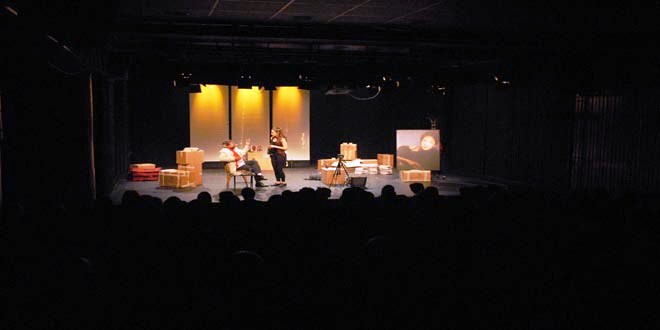
William Shakespeare once said “All the world’s a stage”, but what if this world becomes a stage of war. Despite all the war tragedies and misfortunes, the Syrian theater has sustained a decade of creativity.
It might be because of what Terrence Mann (an American actor, singer, director and professor of musical theater) once said: “Movies will make you famous; television will make you rich; but theater will make you good.” Yes, theater made us good, through tough times.
The Syrian theater through a decade of war has passed through different stages. Nevertheless, how has it managed to survive? That is the question.
The theater, especially during the first years of the war, became dangerous for technicians and actors, who faced the risk of death at any minute on their way to and from work.
However, since war broke out, official theatrical production has persisted. The Directorate of Theaters and Music maintained its scheduled annual plan, yet the number of shows per season varied and were cut down to the minimum, particularly during the first years of instability in Damascus amid the difficulty and risk of the commute for both theater workers and spectators.
The word theater comes from the Greeks, meaning the seeing place. It is a place where people come to see the truth about life and the social situation. The theater is a spiritual and social X-ray of its time and was created to tell people the truth about life.
Therefore, Syrian theater throughout a decade of war, was a place witnessing war traumas, but as well as majorly changing with the new status quo, where recognized theatrical traditions going back to before 2011, have ceased to be. For example, shows were performed earlier in the day to account for checkpoints, transportation hurdles and lack of security. The almost constant power cuts and shortages of fuel oil used to operate generators forced theater workers to seek alternative plans, in case of a power cut during shows that relied on music and lighting.
Operating under the Directorate of Theaters and Music, the Children’s and Puppet Theater continued its productions unabated, with seasonal festivals held during spring and summer.
 The theater, especially during the first years of the war, became dangerous for technicians and actors who faced the risk of death at any minute on their way to and from work, yet they persisted to go to their work. It is noteworthy that many theater workers were among the war’s victims, to mention few: actress Susan Salman, sound technician Shadi Raya and director of programs at the Damascus Opera House Lama Fallouh.
In addition to several students at the Higher Institute of Dramatic Arts that were injured as a result of shells that targeted the building several times. Yet, paradoxically speaking the theater itself as a place underground remained a remote haven from everything happening aboveground, even if only for a few hours.
The Damascus Opera House continued its opera productions, as well as music concerts and dance shows in its three halls. However, the venue did not host theatrical shows.
The Higher Institute of Dramatic Arts continued to present its term graduation projects to spectators annually, amid remarkable presence. The shows were directed by names like Hasan Oweiti, Urwa al-Arabi, Bassam Koussa, Fouad Hassan, Fayez Kazak, GhassanMassoud, SamerOmran, Jihad Saad, Abdel MenhemAmairi and others.
Since the Damascus Theater Festival was suspended in 2010, Syrian theater has been isolated from the Arab and international artistic scene. With the onset of fighting, Syria was prevented from participating in international theatrical festivals because of restrictions on the Syrian passport and the inability of the Syrian Ministry of Culture to cover the travel costs, to reduce its budget. However, some shows managed to overcome the ban and made it, through personal efforts, to the Carthage Theater Festival. Among those shows were The Window (Al-Nafiza) by Majd Fedda, Statico by Jamal Shukeir, which received three awards, and Color Correction (TasheehAlwan) by Samer Mohammed Ismail, which won two awards.
 Urwa al-Arabi’sCity in Three Seasons (Madina fi ThalathatFousoul), Ayman Zaidan’sAbduction (Ikhtitaf), Anna Akkash’sThem (Hounna) and Ajaj Salim’s Chemistry (Kimia) participated in several editions of the Arab Theater Festival, held in a different country every year.
The play Conjugal Confessions (I’tirafatZawjiya) by Ma’moun al-Khatib reached the Cairo International Festival for Experimental Theater. With that, local Syrian theater regained some of the limelight for its productions outside its home country.
The past decade has been marked by a lack of a clear cultural or artistic répertoire of national theater represented by the Directorate of Theaters and Music, in line with the status quo. The artistic quality of shows varied,some shone just once, while others resounded in theater with every new season.All the best performers bring to their role something more, something different than what the author put on paper. That’s what makes theater live. That’s why it persists.
Most performed plays were adaptations of international scripts, some of which carried direct projections of the Syrian war, especially in its early years. Among these were Urwa al-Arabi’sHamlet and About Love and Other Stories, Ayman Zaidan’sAbduction, Fabrika, and Chalk Circle (DaeratTabashir), Ma’moun al-Khatib’sThey Are All My Children (KoulouhoumAbna’i), Pulse (Nabad) and Olives (Zeitoun), Fouad Hassan’s Free Braskovia (Praskovia Hourra) and many others.
The plays that were written specifically for the stage were few, compared to adapted scripts hereinafter mentioned: WaelQaddour’sKharej al-Saytara(Out of Control) and HikayatBalad Ma Fiha Mawt(Tale of a Country with No Death), Kifah al-Khaws’ Bar Fi Share’ al-Hamra(A Bar in Hamra Street), Samer Mohammed Ismail’s Color Correction, Adnan Azrouni’sHudna(Truce), Anna Akkash’sHonna (Them), Faisal Rashid’s al-Wasiya (The Will).
After 2018, the theme of war gradually vanished from scripts, not even appearing in the background. Other subjects from outside this context surfaced and touched on entertainment to please an audience that had grown tired of daily life. Some examples are Ma’moun al-Khatib’sConjugal Confessions, NisrineFandi’sLonely Woman (Imra’aWahida), and ZouheirKanou’sAdrenaline, among others.
In terms of form, Syrian theater opted for the schools of realism in acting and unity of place, like in Yazan al-Dahuk’sSidekick (Comparse), Urwa al-Arabi’sHide and Seek (Tamima), and Mohammed Istanbuli’sHome Always Wins (Al-Bait YafouzDaiman).
Syrian theater stayed away from experimentation and innovation of new artistic forms and visual processes, except when working with students at the Higher Institute of Dramatic Arts.
 Several independent theatrical troupes and collectives worked together to improve the Syrian theatrical scene. Among these groups was OussamaGhanem’s Damascus Theater Lab, which presented Return Home (Awdaila al-Bayt) in 2013, Glass (Zujaj) in 2015 and Drama in 2017. Through these plays, the Lab attempted to dissect the reality of the Syrian family during the war and introduced new viewing habits to the spectator. There was also Kifah al-Khaws’ Hakawati Troupe. They all performed their productions on the stages of the Directorate of Theaters and Music or the Higher Institute of Dramatic Arts.
 However, few theatrical shows left their mark during these 10 years, for several reasons related directly or indirectly to the war, like the absence of cultural and theatrical plans, and lack of resources and financial support. All together played a major role in the alienation of some talented directors who remained in Syria, and in the decline in the theater sector development, which just tried to survive as every other sector in a country torn by war.
When people go into the theater and the lights dim, they seek entertainment from beginning to end. Theater wants them to be swept up in the story, on the edge of their seats, unable to wait to see what happens next, be blown away. That’s the magic of art and the magic of theater: it has the power to transform an audience, an individual, or en masse, to transform them and give them an unique experience and sudden and striking realization that changes their life, opens their hearts and their minds and the way they think. We all hope that Syrian Theater will go back to play its magical role.
Lama Alhassanieh