
A twist in the Tail: Flying Fish Give Clues to ‘Tandem Wing’ Airplane Design
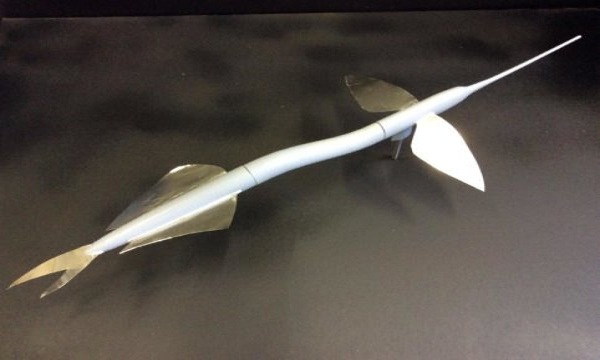
Ribbon halfbeak are a species of fish with the ability to fly above the sea surface — but unlike true ‘flying fish’, they lack the necessary hind wing fins. So how do they fly? Dr Yoshinobu Inada says, “Investigating the design of ribbon halfbeak could provide useful information for the optimal design of tandem wing airplanes.”
According to Science Daily, Dr Inada and his research team present new research on how these fish twist their bodies in order to take flight.
“Ribbon halfbeak fly above the water surface to evade large carnivorous fish and dolphins,” explains Dr Inada, “water is about a thousand times denser than air, so flying through the air is a really practical way to evade predators.”
Not much was previously known about the flying behaviour of ribbon halfbeak, but this research provides new insights into their ability able to glide above the sea surface.
“Other flying fish, including the flying fish, have large pectoral fins that act as wings during flight and large pelvic fins that are used as horizontal tail wings, like those on airplanes,” says Dr Inada, “however, the ribbon halfbeak lacks these large pelvic tail wings.”
“Amazingly, they solve this problem by rotating their rear body by 90 degrees and use their wide dorsal and anal fins as a horizontal tail wing,” adds Dr Inada.
“Other related fish species are also able to jump and fly over the sea surface, but only halfbeak twist their bodies for flight,” says Dr Inada, “this is a really unique behaviour.”
As well as twisting their bodies to create horizontal tail wings and fly, Dr Inada also found that these fish are likely to lift their rear body above the main pectoral wings to reduce the effect of downwash on the tail wings. According to Dr Inada’s results, he says that “this has a positive effect on improving the lift and flight performance of the fish.”
To get these results, Dr Inada 3D printed a physical model based closely on real ribbon halfbeak and analysed its flight performance with different tail wing positions in a wind tunnel.
Mr Junji Yonezawa, a collaborator in the study, believes that this interesting behaviour may be the result of different evolutionary selective pressures to those faced by other flying fish, leading to unique adaptations: “It has the largest number of vertebrae among halfbeaks, which means that it is able to twist the rear half of its body by a whole quarter-turn.
N.H.Kh