
A technical worker designs 4 electronic systems to moisten wheat, saving tens of millions of Syrian pounds
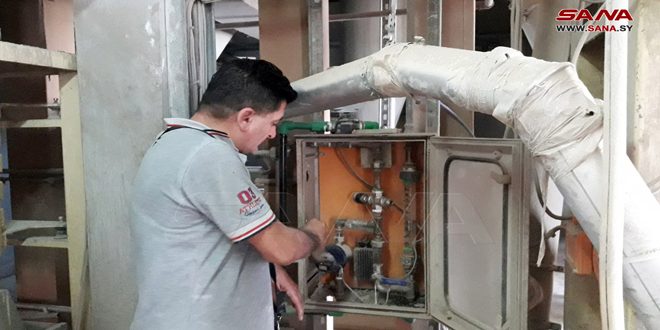
With his unlimited passion for innovation and love for software and its applications, worker Hassan Haider spends his long working hours searching for software ideas to develop old machines. This continuous passion led him recently to design 4 automatic electronic management systems to moisten wheat in Salamiyah Mill in Hama countryside in order to reduce waste and mechanical and electrical problems .
The worker Haidar said, “The general mills suffer from malfunctions in the wetting systems, which in their entirety have turned into manually operated systems due to the antiquity of them and the inability to import new ones due to Western sanctions and the high cost of them. Therefore, I was obsessed with access to an integrated system through which I can operate the wetting system completely automatically.”
Haidar continues, “I have been studying this project for nearly two years with direct support from the administration of the Grain Corporation branch in Hama, which provided me with full support. Then I developed the technical and engineering study for the project according to the availability of software and control parts available in the local market. I designed a specialized computer program capable of programming all the electronic processors of the system. Then the second stage began with assembling the raw software, electronic and control pieces and working on linking them through digital formulas and computer programs.”
Haidar noted that the cost of manufacturing one system did not exceed 5 million Syrian pounds, while its price in the foreign market increased to SYR. 50 million as a minimum estimate. This new system contributes to the introduction of specific percentages of water to moisten the wheat as it monitors the moisture level and allows for a fully automatic control of the wetting process without human intervention.
For his part, the head of the Electricity Department at Salamiyah Mill, Eng. Hussein Al-Qatlabi, stated that the old system was out of order in Salamiyah Mill and the rest of the public mills, and importing them required large sums of money. So there was no choice but to search for an alternative and to be Syrian, and it was decided to design and manufacture a local control system.
Al-Qatlabi confirmed that the technical worker, Hassan Haider, carried out the programming of this system in an innovative and creative way matching external wetting systems, reducing burdens, and resolving errors and problems that were caused by manual moistening.
In turn, Director of the Grain Branch in Hama, Engineer Walid Jakeesh, said that Salamiyah Mill is one of the most important Syrian mills, with a capacity of 600 tons per day. So, it is necessary to maintain this large number of production and of high quality. The worker Hassan Haider provided innovative solutions to the problems encountered milling operations in more than one site and due to its efficiency, the project of manufacturing systems was adopted.
Jakesh expressed his hope that this system will be generalized to all mills to benefit from this achievement.
It is noteworthy that the four systems saved about 180 million pounds, which is the first entirely local innovation supported by the design of an industrial computer program to coordinate tasks.
Inas Abdulkareem