
A roadmap for a knowledge-based economy in Syria
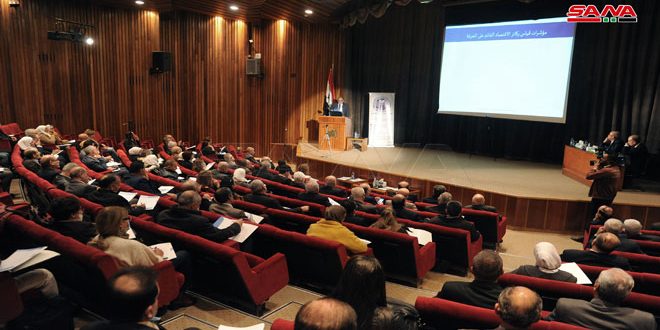
Academics and researchers discussed on Wednesday the proposed roadmap for a knowledge-based economy in Syria, within a workshop organized by the Supreme Commission for Scientific Research in cooperation with the United Nations Economic and Social Commission for Western Asia “ESCWA” at Al-Assad National Library in Damascus.
The workshop, which was attended by researchers and representatives of universities, scientific bodies, institutions and ministries, included presenting a report on concepts related to the requirements of a knowledge-based economy and the future vision of this type of economy in Syria. The workshop focused on the role of scientific research bodies in creating knowledge and ways to invest it in supporting the national economy. The interventions of government and private agencies to enrich the proposed report and correct it which would pave the way for its adoption and the transition to the implementation phase were also on the table.
Minister of Higher Education and Scientific Research, Dr. Bassam Ibrahim, stressed in his speech the importance of investing the knowledge produced by Syrian universities, bodies and research centers and linking it to the real needs of society, its support for the national economy and economic development, and its contribution to addressing the repercussions of war. He pointed out that the ministry’s goal at this stage is to focus on scientific research on economic development and social service.
Director General of the Supreme Commission for Scientific Research, Dr. Majd Al Jamali noted that the transition to a knowledge-based economy is inevitable, stressing that there is a clear global transformation that must be accompanied through a national strategy. He underlined the importance of the role played by educational institutions and universities in facilitating knowledge and supporting students in this field.
For his part, the Regional Adviser of Technology for Development at ESCWA, Dr. Nawar Al-Awa, said that ESCWA is working to support government agencies in developing policies and strategies for the transition to a knowledge-based economy, digital economy and digital government, and encourages government institutions to employ technology to transform into smart societies in order to improve the quality of life, create new job opportunities for young people and put an end to corruption and waste of resources.
Rector of the Syrian Virtual University and National Consultant at ESCWA, Dr. Khalil Al-Ajmi, presented the proposed report, which included indicators for measuring the pillars of the knowledge-based economy, an analysis of the current situation in Syria, the most important weaknesses and strengths, the most important opportunities and challenges. He noted that the simple amendments to the administrative and financial system in which we work in the public sector but without causing any harm, can achieve very huge returns and profits.
In turn, Dr. Uday Sultan, a researcher in knowledge economy, asserted that this economy is based on four indicators, namely the economic and institutional framework, information and communication technology infrastructure, education and training, creativity and innovation. These indicators constitute the road map for Syria in its orientation towards a knowledge-based economy that depends on knowledge, technology, creativity, innovation, education and training contrary to the traditional economy based on three main sectors: agriculture, industry and services. He underlined the need to develop legislation regulating the work of the state, developing laws, wages of workers, and criteria for selecting faculty members in universities, as well as the law on organizing universities and supporting the Scientific Research and Technical Development Fund in the Ministry of Higher Education.
Inas Abdelkareem