
A pioneering agricultural experience for a young Syrian that produces 10,000 cypress trees
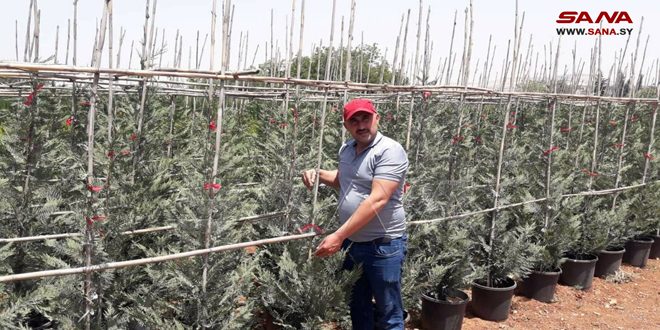
His love for green nature and his constant passion for discovering rare species led him to cultivate 10,000 cypress plants of the Italian Lilandi kind after he brought in small cuttings during a brief visit to the Italian city of Pistoia.
He is the young Bashar Qateel, whose early upbringing was between plantings and seedlings, under the care of his father, who was one of the pioneers of agricultural nurseries in Hama This helped him master all the secrets of cutting and cultivating fruit and ornamental trees.
Today, Bashar is obsessed with doubling the production of this tree, which is called the Royal Palaces and Castles Tree, at a time when fires have exhausted our forests, gardens and the mountainous green spaces.
Qateel told SANA, “During my visit to the Italian city of Pistoia, by virtue of my work in agricultural nurseries, I saw this tree adorning the wall of one of the city’s palaces. I managed to get simple cuttings from that tree and did several cultivating and grafting experiments in my nursery south of the city of Hama, which extends over an area of several dunums where I allocated a large place to produce and care for this unique tree.”
He added, “I pull simple 15-centimetre cuttings of the Lilandi tree and I graft them on the local cypress, then we serve and care for them for a whole year inside green houses, then it is moved to the open air inside a network of reeds in order to grow, rise, and tighten their stems. Reeds are added at this stage because it helps the plant to grow vertically and straight. Their presence in the open air helps it to harmonize and become accustomed to the nature of the Syrian climate to which they have adapted as a result of the lack of large differences between the Syrian and Italian climates.”
This tree, according to Qateel, enjoys the beauty of its appearance. It rises and then hangs in a beautiful geometric form and gives a unique aesthetic view of the gardens and walls of the houses where it adorned the ancient Italian palaces and is cut in several geometric forms.”
He continues: “Agricultural knowledge of this tree must be expanded and its cultivation technology transferred to all Syrian nurseries, although part of my experience with this tree has been transferred to my fellow nursery owners. We hope that its cultivation will extend to the mountainous areas that have suffered damage from fires over the past years, indicating that today this tree is in great demand and has a promising export future, especially to Lebanon, Iraq, and Jordan.
With regard to the experience of Qateel, agronomist Alaa Sukkariya confirmed that this experience is unique and constitutes a real addition to the experience of Syrians in agricultural production, especially since the Italian Lilandi cypress has a unique aesthetic advantage from the local cypress. The local one has a greenery extension either horizontal or vertical, while the Italian Lilandi category combines the horizontal and vertical features.
Eng. Sukkariya noted the ability of this type of tree to adapt to the local environment without any problems due to the grafting technique on the local origin, pointing to the use of this item in the decoration of public and domestic gardens and intensifying the vegetation, as well as in mountain areas where vegetation is being patched.
Amal Farhat