
A bird in the hand is worth two in the bush
Meaning
It’s better to have a lesser but certain advantage than the possibility of a greater one that may come to nothing.
Origin
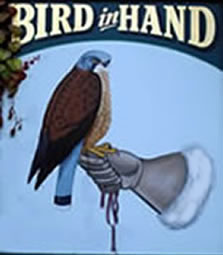
This proverb refers back to mediaeval falconry where a bird in the hand (the falcon) was a valuable asset and certainly worth more than two in the bush (the prey).
The first citation of the expression in print in its currently used form is found in John Ray’s A Hand-book of Proverbs, 1670, in which he lists it as: A [also ‘one’] bird in the hand is worth two in the bush
By how long the phrase predates Ray’s publishing isn’t clear, as variants of it were known for centuries before 1670. The earliest English version of the proverb is from the Bible and was translated into English in Wycliffe’s version in 1382, although Latin texts have it from the 13th century: Ecclesiastes IX – A living dog is better than a dead lion.
Alternatives that explicitly mention birds in hand come later. The earliest of those is in Hugh Rhodes’ The Boke of Nurture or Schoole of Good Maners, circa 1530: “A byrd in hand – is worth ten flye at large.”
John Heywood, the 16th century collector of proverbs, recorded another version in his ambitiously titled A dialogue conteinyng the nomber in effect of all the prouerbes in the Englishe tongue, 1546: “Better one byrde in hande than ten in the wood.”
The expression fits well into the catalogue of English proverbs, which are often warnings, especially warnings about hubris or risk taking. Some of the better known examples that warn against getting carried away by that exciting new prospect are: ‘All that glitters is not gold’, ‘Fools rush in where angels fear to tread’, ‘Look before you leap’, ‘Marry in haste, repent at leisure’, ‘The best-laid schemes of mice and men gang aft agley’
The Bird in Hand was adopted as a pub name in England in the Middle Ages and many of this name still survive.
English migrants to America took the expression with them and ‘bird in hand’ must have been known there by 1734 as this was the year in which a small town in Pennsylvania was founded with that name.
Other languages and cultures have their own version of this proverb, notably the Czech ‘Lepsi vrabec v hrsti nez holub na strese’ (A sparrow in the fist is better than a pigeon on the roof.).
Compiled by Maher Taki