
Archaeological “Tal Diab” Site Rich Civilization Witness to Syrian Al-Jazira Area
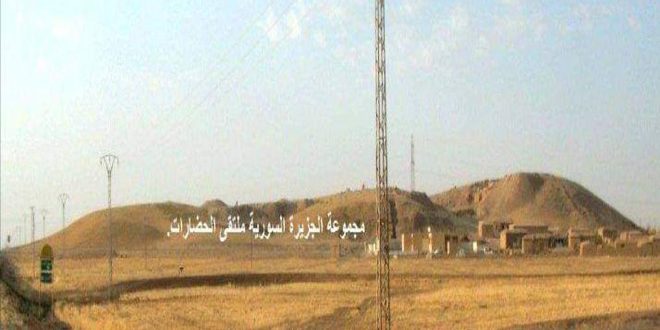
The Syrian Al-Jazira area has witnessed through its history a number of remarkable deep-rooted civilizations due to its historical, natural, human and economic importance.
On the left bank of Wadi Abbas, 125 km northeast of the city of Hasaka, the ancient Tal Diab is located .It is a rich witness to the successive civilizations on the Euphrates River and the Syrian Al-Jazira area.
The archaeological excavations at the site have revealed since 1987 the eras which the site witnessed including Akkadian, Mitanni, Assyrian, Greek, Hellenistic, Parthian, Roman and Arab-Islamic civilization.
 The archaeologist Dr. Abd al-Masih Baghdou pointed out that a collection of tandoors and large pottery jars used for storage were discovered at the archaeological site, in addition to several graves, one of which included a set of pottery vessels and bronze tools dating back to the end of the Akkadian era.
Baghdou explained that the archaeological discoveries found parts of a palace dating back to the Akkadian period. The palace consisted of three large rooms and a square covered with with basalt stones, and two buildings located on the northern side which were used as stores and warehouses for the palace. A third building was also discovered consisting of several rooms and a street separating the buildings belonging to the palace.
According to Baghdou, a cemetery dating back to the fourteenth century AD was also placed on top of the palace, in addition to parts of a building dating back to the Akkadian period nine meters long which contained a four-meter-long kitchen next to it was an open- yard and a huge wall with stone foundations two meters wide for rooms built of basalt stone which date back to the post-Akkadian period..
 The archaeologist underlined that the most important discovery at the site is that of two temples and residential buildings dating back to the Khabur era which include a collection of important artifacts such as pottery vessels engraved with Indian, animal and plant figures dating back to the Middle Bronze period, parts of cuneiform inscriptions, and a cylindrical seal of an ancient Assyrian style showing the ancient name which the Assyrians used for the site, which is the land of Abum.
Rawaa Ghanam