
The First Complete Syrian Translation of The Novel, “Les Misérables” Issued by the Book Authority
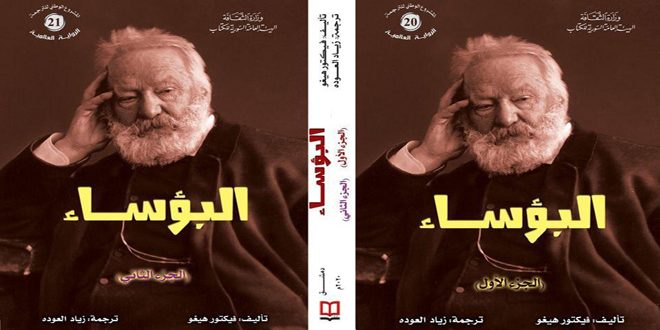
There is no fictional work that has gained so much popularity, despite the sadness and misery it contains like the novel “Les Miserables”, by the French writer Victor Hugo. It was considered the most important among his works, which were about fifty. Many writers were inspired by its plot as it appeared dozens of times on stage and on film and television screens.
Despite the importance of the novel, it was not fully translated into Arabic except once in the 1950s by the late Lebanese writer and translator Munir Baalbaki. Later on, short versions of it appeared in Arabic with fragments of several chapters. Now the Syrian General Book Organization is presenting the second complete Arabic translation of “The Miserables” which is the first of its kind among the publishing institutions in Syria.
This new translation of “Les Miserables”, is printed in two volumes to reduce its large 582 pages of medium size to make the reading more enjoyable. It was translated by Zyada al-Awda, who is one of the most important translators of the French language in Syria and the Arab countries, using his vast experience in translating some of the most beautiful writings of French writers to our language, such as the novels: The Legend of Don Juan and Mauriac and now “The Miserables”, which was published in its new form with simple expressive language that narrates the suffering of its famous hero Jean Val jean because of his recklessness , and how Father Merrill, with his kindness and humanity, was able to transfer his soul to the world of goodness and love.
Hugo, during his novel, expresses the extent of injustice and misery under which the poor French people lived in the aftermath of the 1789 revolution and the Napoleonic wars.
He was inspired by the facts that he witnessed in the trial of a person for stealing a loaf of bread and the help of a cleric for him, to formulate it as one of the most important products of French literature in the 19th century.
Amal Farhat