
Rafiq Salloum .. A Syrian martyr , poet and resistant to the Ottoman occupation
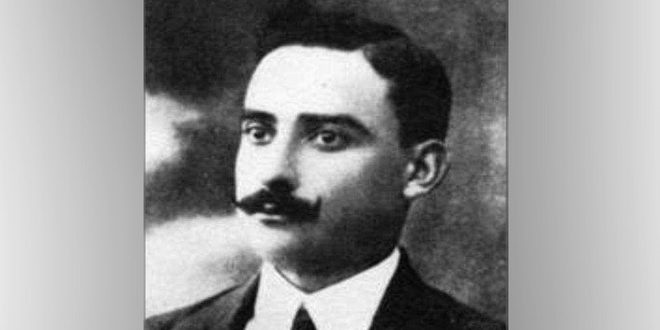
The late poet Rafik Rizk Salloum’s poem, which he composed in front of the gallows of the martyrs of May the 6th , is still crying out for vivid consciences, arousing enthusiasm and urging resistance, as if this poem written before more than 100 years ago is suitable for our time and speaks in our tongue..
To document the biography of that resistant poet, the Damascus History Foundation prepared a study for the Wikipedia website to be published on its pages, based on the agreement signed between the two parties last June, which stipulated that the Foundation provides the website with biographies of 100 documented and verified Syrian personalities.
The poet addressed his countrymen and his nation before his execution, calling them to avenge the Ottoman occupier when he said: “Neither the Arabs are my family nor Syria is my home if they do not revenge”.
The poet was born in the city of Homs in 1891 and educated in its schools, and while his family was hoping for him to become a cleric , he took off the dress of monasticism early and went to Beirut to study at the Syrian Protestant College, “the American University of Beirut,” and while he was still a student, he wrote his first novel, “Diseases of the Modern Age.”
After he finished his studies in Beirut, he traveled to Istanbul to study law, and there he wrote to the major Arab newspapers and magazines and worked as an editor for Al-Hadara newspaper published by Sheikh Abdul Hamid Al-Zahrawi.
During that period of his life, he wrote a comprehensive book on economics entitled “The Country’s Life in Economics,” and by the time he finished studying law, he had mastered the Russian, Greek and Turkish languages.
Salloom had a fondness for music, so he mastered playing the instruments of the lute, the violin and the piano. He was also one of the most important contributors to the establishment of the Literary club, which aimed at the coalition of Arabs and the preservation of their rights and the independence of their country.
In 1914, the Ottoman occupation authorities brought Sallum to service with their forces participating in the First World War, and there he was able to communicate and coordinate with the factions opposed to this occupation.
In 1915, Salloum was arrested after they informed the Ottoman authorities about his activities against the Ottoman occupation ,and he was transferred to the Military Court in Aley, where he was sentenced to death by hanging.
At that time he sent an influential letter to his mother in which he described the torture he had experienced during his arrest and interrogation and mentioned the names of the persons who had insulted him and forgave them.
On the morning of May 6, Sallum was executed while he was still a young man at the age of twenty-five, and he had a number of free men with him including Shafiq Muayad al-Azm, Rushdi al-Shamaa, Shukri al-Asali, and his teacher Abd al-Hamid al-Zahrawi.
The officer at the Ottoman occupation army Fouad Arden described in his memoir Salloum’s stand at the moment of death and how he walked with steady and rapid steps. He saluted the body of the martyr Al Zahrawi, describing him as the Father of Freedom, and improvised his poem in which he calls on Syrians and Arabs to avenge the martyrs of May 6 and to liberate themselves from the Ottoman occupation.
In the will that Sallum left, as extreme evidence of his feelings and his sense of belonging to the homeland and the nation, he asked that verses from the famous poem of the poet Almuqanna Alkindi be written on his grave “The One Who had between me and the sons of my father” to express his belief in Syria, his Arabism and his defense of his fellow countrymen, even those who betrayed him and handed him over to death..
Rawaa Ghanam