
Apollo statue in a Asria Temple … a unique Syrian icon in the region
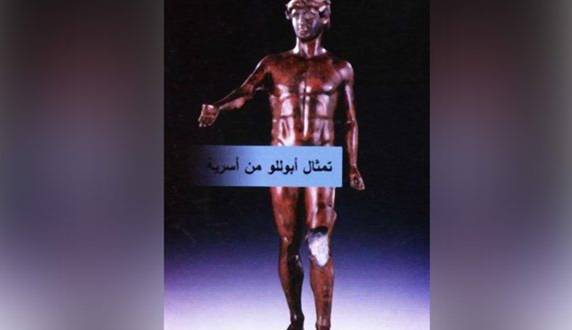
The Statue of Apollo, the God of music and literature for the Greeks which was discovered at Asria, East of Salmiya city, is one of the most important statues found in the east for this Greek god.
The statue which exists today in Damascus National Museum, was made in the form of a graceful and handsome young man. It was found along with a broken lyre by a German expedition that excavated in Asria Temple between 1991 and 1992.
Archaeological researcher Dr. Khaled Kiwan explains that the statue, which is 53 centimeters high, made of bronze , has been cleaned and is now displayed in one of the stands of Damascus National Museum, indicating that Apollo, which is the equivalent of the Palmyrian god, Nebo in ancient Syria, is also the god of prediction, which explains the dedication of Asria Temple to the prophecies.
The statue has a Roman character representing the Caesar era, with Greek and Hellenistic influence, but it lacks the wreath on the head.
The presence of this statue in Asria indicates the importance of this site from a religious point of view. It is also likely that the temple was built before the Roman era, but after the domination of the Romans over the region they made it as their temple.
The statue was done in the usual traditional form, i.e., in a standing position, turning to one side, where in this model, he turns slightly to the right and covers his head with something like a longitudinal helmet. It is also noted that he focused his eyesight on the far horizon, extending his right hand and spreading out his palm as if he was pointing to something or giving something while he was relaxing his left hand and placing his left leg in front of the right one .
We can compare Asria’s statue to another statue of the god Apollo, dating back to (320- 350) BC, preserved in the Vatican Museum. It appears with almost the same movements as the Asria statue, except that it was made of marble stone, and its body is leaning forward in a standing position, turning its head to the left side. This statue probably dates back to the same era of the Asria statue.
It is noteworthy that Asria temple dates back to the 1st century BC and includes new additions dating back to the early third century AD, at the time of the Syrian Emperor Caracalla, who ruled Rome between 211 and 217 AD.
Amal Farhat