
Atil temples in Sweida a witness to great civilization in Syria’s southern region
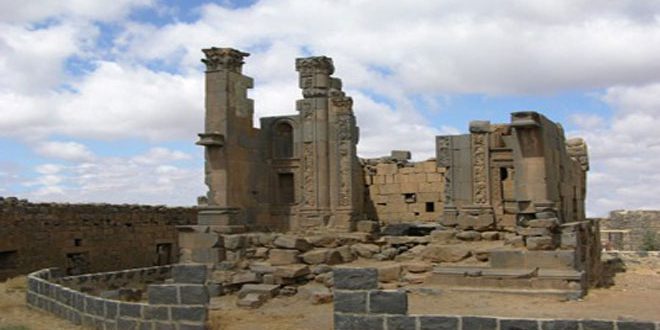
Sweida, (ST) – Atil in an old inhabited small Syrian town located about three kilometers north of the city of al-Sweida. It is protected by its unique architectural art and its name gives it a historical importance as it means the strong well-fortified site.
The town contains several archeological sites, most remarkable of which are the two ancient temples, whose architecture structure and the floral and geometric shapes that adorn them reflect the beauty of the ancient architecture in Syria’s southern region.
Atil is known of its civilized heritage that presents a story about the archeological sites and historical landmarks in Sweida. These sites, which date back to the Nabataean Age in the first century B.C., are a witness to many successive civilizations with its churches and mosques that were converted from temples in the Roman era.
Director of Sweida Antiquities Department Nashaat Kiwan told SANA that “among the most prominent archeological sites in the town of Atil are two almost identically designed Roman temples, delicately fashioned from the local basalt stone.
The South Temple stems from the Antonine period (AD 151), the second or North Temple (probably dedicated to the Nabataean deity, Theandrites) was built in AD 211–212.
The southern temple, registered as a historical monument, was built during the Roman era mid-second century AD, Kiwan added.
The history of the site is explained in writings in the Roman language on the right side of the temple’s entrance.
Kiwan indicated that the South Temple’s courtyard includes a variety of artifacts, including columns with beautiful sculptures that represent different shapes in addition to decorated walls and other art pieces that indicate the richness of this archeological monument.
Between these two temples, dwellings are located on both sides of a street that runs from north to south and is cut by sub-streets, said Kiwan, pointing out that many Greek writings, representing gifts and vows submitted by different personalities to Atil temples, were found in this place.
Archeologists hailed the distinguished construction of the two temples and of the long road linking them, Kiwan added.
It is noteworthy to mention that Atil town was mentioned in Greek writings as Attila and it dates back to the Nabataean era in the first century BC. It contains many monuments including religious temples and residential houses built of basalt.
Raghda Sawas