
Al-Jaafari: Syria rejects any future conclusions by the OPCW’s FFM team on alleged chemical incident in Douma
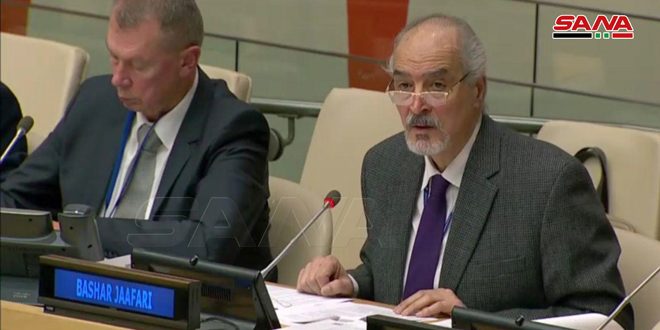
NEW YORK, (ST)- The UN Security Council convened late Monday to discuss the report of the Organization for the Prohibition of Chemical Weapons (OPCW) on the alleged use of chemical weapons in the Syrian city of Douma in April 2018.
On March 1, the OPCW Fact Finding Mission (FFM) issued a 100-page final report, claiming that chlorine was used during an attack in Syria’s Douma on April 7, 2018. The report was submitted to the United Nations Security Council through the UN secretary general and specifically states that the cylinders containing chemicals that were found at the incident site were airdropped.
However, a new report signed by OPCW expert Ian Henderson emerged on the Internet in May, stating that both cylinders were likely to be placed at the incident site rather than airdropped. These conclusions support Russia and Syria’s narrative that the incident was staged, however, they were not included in the final report of the organization.
Syria’s Permanent Representative to the United Nations, Dr. Bashar al-Jaafari, stressed during the meeting that western countries, mainly the United States, are working to politicize the work of the Organization for the Prohibition of Chemical Weapon (OPCW) in order to serve their own agendas.
He reaffirmed Syria’s rejection of any future conclusions by the OPCW’s FFM team on the alleged chemical incident in Douma.
He made it clear that since its creation, the FFM hasn’t been honest in implementing the rules of the OPCW. For example, it conducts its investigation remotely, depends on its information on so-called “open sources”, approaches political issues and falsifies facts.
Al-Jaafari went on to say that “the leaked information, particularly the important report presented by the OPCW expert Ian Henderson, a member in the organization’s fact-finding mission who visited Douma, contradicts the report issued by head of the office of the OPCW’s Secretary General.”
Henderson has admitted that the results of the OPCW’s report don’t go in conformity with facts on the ground and they contradict the engineering report, said al-Jaafari.
 He went on to say that the FFM team had visited the site of the alleged incident, but this team was prevented from participating and compiling the FFM’s Douma report which was issued by the OPCW.
He reiterated that it is time for the OPCW to adopt tangible immediate procedures to protect its independency, position and credibility and not to allow some countries to destroy the organization as they did with the League of Nations and are trying to do with the United Nations.
He pointed out that the countries which launched a military aggression on Syrian territories on April 17th, 2018 exploiting the alleged chemical attack in Douma, are the same countries which defended the report of OPCW even before this organization starts investigation into the alleged incident.
Al-Jaafari underscored that some countries are trying to repeat what happened in Iraq in Syria and trying to find pretexts for the aggression on the country, “but, we will not allow this to happen”. He clarified that the United States invaded Iraq after falsifying the documents issued by different missions and committees to justify its aggression regardless of the mission’s attempts to confirm that there were no Weapons of Mass Destruction in Iraq.
He made it clear that the story of the so-called use of chemicals didn’t start in Douma. It started long time before, specifically on December 8th 2012. On this date, al-Jaafari said, the Turkish “Yurt” newspaper reported that “al-Qaeda members are producing chemical weapons in a laboratory near the Turkish city of Gaziantep to use them against Syrian civilians in order to blame the Syrian government for these attacks.” He added that the Turkish newspaper drew attention to the videos posted on the internet by al-Qaeda demonstrating how to make poison gas from such chemicals that al-Qaeda had obtained from Turkish companies and tested on living creatures (rabbits).
Hamda Mustafa