
Fallouh criticizes political hypocrisy of some Security Council members regarding the humanitarian situation in Syria
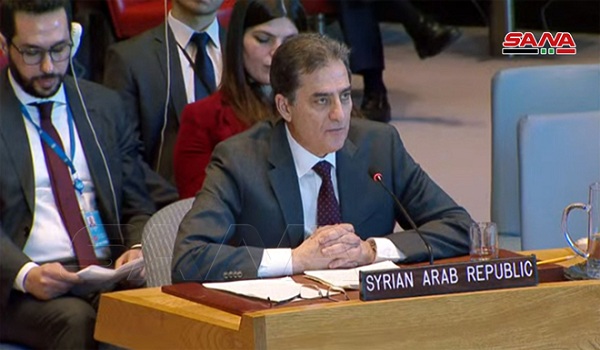
New YORK, (ST)- The Charge d’Affaires of the Syrian Permanent Delegation to the United Nations Louay Fallouh has criticized the political hypocrisy of some Security Council members regarding the humanitarian situation in Syria.
Commenting on the draft resolution on an unacceptable mechanism for transporting humanitarian aid to Syria and that was vetoed yesterday by Russia and China, Fallouh said that it is the highest level of political and moral hypocrisy when some Security Council members talk about a humanitarian crisis in Syria while they launch aggression and impose siege on the Syrian people.
Fallouh made the remarks during a UN Security Council session on Friday following the Chinese and Russian double veto against a draft resolution, submitted by the so-called “humanitarian co-penholders” (Germany, Belgium, and Kuwait) about transporting humanitarian aid to Syria which exploits the situation in the country and violates its sovereignty.
He thanked Russia and China for blocking the draft resolution, pointing out that this step would contribute to preserving the principles of the international law and the UN Charter, mainly respecting the sovereignty of countries and rules of humanitarian action.
He reiterated Syria’s complete rejection of the draft resolution, criticizing the unbalanced policy of the so-called “humanitarian co-penholders” on Syria in which they present such a draft resolution based on some propagandas which are usually launched by representatives of the United Nations Office for the Coordination of Humanitarian Affairs (OCHA) for manipulation purposes before each time the authority of the Security Council Resolution No. 2165 is extended.
He wondered how some Security Council member states and the so-called “humanitarian co-penholders” remain silent towards the US occupation forces’ looting of the Syrian oil and gas.
He also called for immediately lifting the unilateral, coercive economic measures imposed on the Syrian people.
Hamda Mustafa