
Dr. Shaaban: Syria has treasures of oral history and “Wathiqat Watan” seeks to preserve the country’s cultural identity
The past eight years of foreign-backed terrorist war on Syria have badly affected the life of all the Syrians and produced a lot of painful experiences so that one can hardly find a Syrian who hasn’t suffered in one way or another or who doesn’t have a touching story to tell.
To provide a platform for all the Syrians who have encountered ordeals or passed through hardships during the war to speak or write about what happened to them, Wathiqat Watan, a national non-governmental and non-profit organization established in 2016, launched last August a competition called “Hekayati” (my story) for best short true story. The aim has been to tell the world the truth about what happened in Syria and to disseminate awareness about writing Syria’s history in order to preserve the national memory from loss or distortion and to document the details of the heinous war on Syria through people’s stories.
Wathiqat Watan organization received, over two months, hundreds of stories by Syrians of different age categories from all provinces. The stories were studied by a team of researchers and experts at the organization and in fact, it wasn’t easy for members of the jury (writer Nabil Saleh, journalist Nahla al-Susou and writer Hasan Hamid) to select from among 475 stories only twelve works to win the competition’s prizes, since most of the stories were well-written and deserved to winning the researchers stressed.
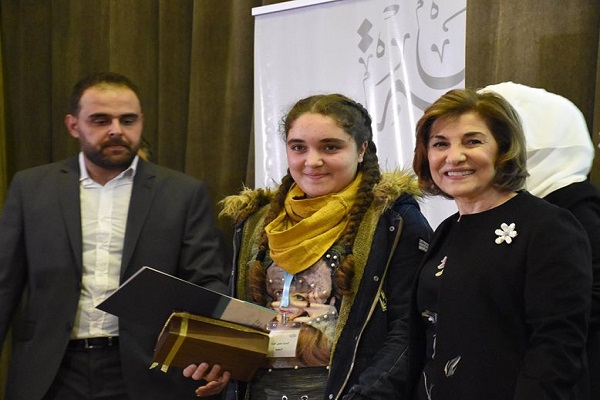
 The results of the competition were announced on Sunday, December 15th during a ceremony held by Wathiqat Watan at Al-Assad National Library in Damascus to honor the winners.
Winners were divided into four age categories:
In the 10-16 years category, Hanin al-Qibeh, Majd Eddin Eid and Dana Darwish were respectively the top three.
In the 17-30 years category, Najlaa Saeed, Rahmeh Za’mout and Gharam al-Ali occupied the first three positions.
Winners in the 31-50 years category were Firas al-Qadi, Tamer Dabbas and Wasim Mustafa while winners in the above 50 age category were Mohammad Shahoud, Randa al-Qaesm and Martin Tamras.
Winners of the first place got SYP 300,000 each, winners of the second place got SYP 200,000 each while winners of the third place got 100,000 each.
Syria has treasures of oral history
 Dr. Bouthaina Shaaban, the Chairperson of the Organization’s Board of Trustees, thanked all the writers of the stories and encouraged them to write more to contribute to writing the history of their own country. She added that “Hekayati” will be an annual competition, vowing that the stories will be archived as documents by the organization and will be translated into living languages so that “the world can read our true history and our enemies will fail to distort our history and write it the way they want.”
In a press conference following the ceremony, Dr. Shaaban said that after the war on Syria, which witnessed huge disinformation about what was really going on, “we, in Wathiqat Watan, decided to write the history of Syria with the help of the citizens, so we went to all provinces and conducted interviews with many people to speak about what happened to them during this war.
The aim was to preserve our ancient cultural identity and to express pride in the unique coexistence which Syria is famous for, she stressed, reiterating that Syria has treasures of oral history.
Winners’ stories
Hanin al-Qibeh, a winner of golden prize from the 10-16 age category and a daughter of a martyr, told the Syria Times e-newspaper that she participated in the competition to allow the coming generation to read about “our” experience during the war. “My story depended on real events. It depicted how beautiful and peaceful life in Syria was before the terrorist came and turned it into a nightmare. The story talks about the martyrdom of my father and my two uncles and about a letter written by my mother before the terrorists entered our village,” which is the most touching part of the story.
Hanin’s story is titled “My Mom’s Letter”. Place: Entrance of Idleb City. Time: March 2015. Part of the story says that before the gunmen entered the village, Hanin’s mother went to the pharmacy and returned after buying two boxes of pills- poison and sleeping pills- and a bottle of juice. She intended to poison herself if the gunmen attacked her house.
“We surrendered to sleep dreaming of the juice … in the morning the streets were filled with cars of people departing going in one direction and fighters in the opposite one … my mother went out to get some food … whatever was available albeit scarce …. I was looking for some clothes, when my hands found a paper with my mother’s handwriting: [Gunmen will not enter the house, except over my dead body … as for the young ones, I gave them sleeping pills; you will find them hidden between luggage and stuff in the attic]… a similar message was on her mobile sent to my father so he can come and save us,” Hanin’s story reads.
 Another golden prize winner was Najlaa Saeed from the 17-30 years category. She told Syria Times that she heard about “Hekayati” competition and its objectives, so she immediately started to write her story in which she talked about the tragic loss of her friend in a mortar attack that targeted their school.
Her story titled “My School Friend”
Place: Akrama Al-Makhzoumi School, Homs
Time: October 2014
Part of the story reads: “A mortar fell from the sky to my right … screaming and running filled the class … something pushed us strongly towards the outside, while thick black smoke filled the place for long minutes … Mudhar’s seat was burning … I came close to find Mudhar’s charred dead body with smoke still coming out of it … At first, I did not understand what had happened. I needed calm to understand … a pain wave squeezed my heart … I put my hands on his charred face. It was very hot. His face was so hot, more hot than when we ran up the hill panting …. I called his name, but he didn’t answer … I called him again with broken voice: Moudhar .. the class has ended … aren’t we going to the movies? Come on, please stop fooling me.”
Other winning stories depicted different real incidents like exiting Deir Ez-Zor and the heroic deed of Saving Real Estate Documents in Homs.
Government’s support
Minister of Social Affairs and Labor Rima al-Qaderi told Syria Times that Wathiqat Watan is one of the non-government organizations working in Syria with a very important objective that affirms the need that the Syrians write their own history, not only the ongoing events, but also the civilization, the heritage, science, culture and all the rich and diverse details in Syria.
She stressed that this objective has got the support of the government, represented by the Ministry of Social Affairs and Labor in order to help the organization take a step on the ground and continue with its project.
“Today we saw the positive results of the organization’s first achievement and realized how successful this experience was, so we encourage such activities due to their very important goals,” al-Qaderi said, stressing that “the more we shed light on historical richness and diversity in Syria the more we understand our homeland, love it and feel proud of it.”
 Assessing “Hekayati” competition after the results, Dr. Mousa Khouri, the Director of Projects in Wathiqat Watan, told ST that “Hekayati Prize was an initiative to support the idea of oral documentation and revive the idea of writing by the people to help them take part in writing their own history.”
“After we received the stories, judged them and distributed the prizes, we noticed that the results of the competition were excellent and more successful than we expected,” he added, pointing out that more stories are expected to be written and that the rest of stories, which didn’t receive prizes, will be kept in the archive of the organization and as a data base and some of them will be selected to be published.
The war on Syria is only one of the axes of Wathiqat Wattan’s work. Other projects include antiquities, the church heritage, the Arabic language, the Syrian popular food and documenting and preserving the Aramaic language.
Report and Interviews by: Hamda Mustafa