
The Monastery of St. Elian the Hermit “Whispers of the past and visions of the future”
Part (1)
Syria is widely considered the birthplace of Christianity and boasts a wealth of religious sites which attract tourists from all over the world, including the Convent of Our Lady of Sednaya, the monasteries of Maaloula and the shrine of St. Marun, the patron saint of the Maronite sect. These are of great significance as primary sites of Christian worship. Every day, studies and investigations reveal new sites of interest and one of these is the Monastery of St. Elian the Hermit in Homs.
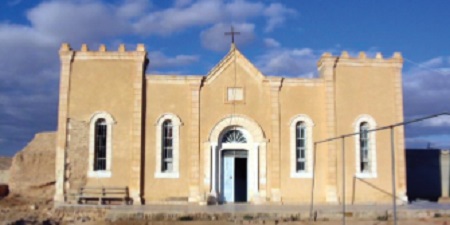
The Monastery of St. Elian is approximately 4 km west of the oasis of Quryatein in the Syrian desert, approximately 85 km from Homs city centre, and its history stretches back to the 3rd millennium B.C. when it was an important stopping place for caravans of merchants and pilgrims crossing Mesopotamia and the Mediterranean on the Silk Route. The monastery was named after Saint Elian. The most noteworthy source of this information were the hymns of St. Ephraim al-Syriani, one of whose disciples was St. Elian himself, who penned 24 poems in praise of his teacher.
St. Elian was born in Arzan, near Babylon on the Euphrates and became renowned for his asceticism, fasting and miracles healing the sick, as well as for his self-imposed periods of seclusion in the caves in the mountains of Edessa. He gathered around him over 100 students who followed his example, living his life of piety and asceticism. According to 17th century manuscripts, St. Elian died in 364 A.D. and was buried by his student monks near Quryatein with great sorrow and humility.
 They later placed the remains of their saint in a carved marble grave and built a small church around it. Then they constructed a monastery for themselves, subsequently named the Monastery of St. Elian the Hermit. From here sprung ascetic, monastic life in the wilderness.
 Amongst the important archaeological discoveries revealed by the National Mission for Excavation, which is still active in the Monastery of St. Elian, is the tomb of the saint himself which dates back to the 4th century A.D.
The work to uncover the monks’ cemetery which was parallel to the door of the church began after the church collapsed in 1938. This graveyard dates back to the 14th century A.D. What is interesting here is that all the graves that were opened contained excellently preserved skeletons, with even remnants of fabric from the garments of the deceased and strands of hair. This remarkable fact encouraged the excavation team and excited their curiosity to discover more about the graves. Amongst further surprises was evidence of human flesh and also what appeared to have been a wooden wagon with metal wheels.
The door of the monastery dates back to the 17th century A.D, and is currently to be found in the Antiquities Department of the Syrian National Museum in Damascus. It is one of only 6 wooden church doors in the Arabian East dating from the Byzantine period that is still intact.
 The frame and panels are made of cedar wood and it faintly resembles the doors of the Chapel of St. Sabina in Rome and the door of the Church of the Blessed Virgin in St. Catherine’s Monastery in Sinai.
One of the panels is to be found in the Frederick Museum in Germany, where research is being conducted on it.
The monastery is surrounded by a rectangular, mortar wall and on the south easterly side of the wall is a tower, made of Arabic clay and all but destroyed.
The monastery has a beautifully embellished slam door located in the south of the wall. This was constructed small in size as were other old monastery doors to impose humility and respect on those visiting the site. In addition this helped to isolate the place and protect it from attack.
Adapted by: Haifaa Mafalani