
Russia’s impatience with Turkey in Syria
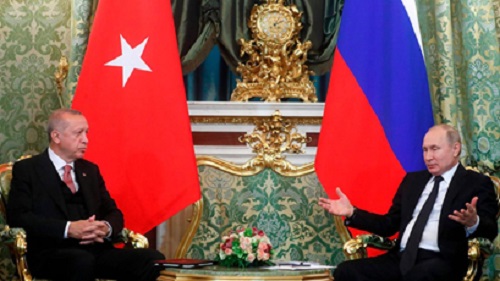
Turkey’s involvement in the heinous war against Syria has indeed added salt to the deep wounds of Syrians. Turkey, under the leadership of Mr. Erdogan, has spared no efforts to prolong and blindly support every terrorist factions as to slaughter the more of Syrians.
According to globalrisksinsight, on August 2, a ceasefire in Idlib was announced. It did not last long as three days later fighting resumed.
Previously, Turkey and Russia managed to reach an agreement for a ceasefire in Idlib in September 2018 when fears were mounting that the Syrian Army would launch an offensive.
It is noteworthy to mention that the Turkish economy was struggling, and the public’s attitudes towards Syrian refugees was changing to unwelcoming. Idlib was also home to Syria’s most extreme factions such as Hayat Tahrir al-Sham (HTS), a successor to the al-Nusra front .
The two nations agreed in a memorandum signed in the Russian city of Sochi that called for the establishment of joint Turkish-Russian patrols along with an agreed-upon demilitarised zone.
Damascus has long rejected Turkey’s illegal occupation of some of its soil with the frequent demands by the Syrian political officials for Ankara’s withdrawal from Syria.
Russia has warned Turkey that approval from Syria would be required if Turkey was to conduct any operations on its soil.
However, Russia’s patience with Turkey appears to be waning over their failure to disarm or remove terrorists from Idlib. From the onset, President Putin repudiated President Erdogan’s call to halt an attack by labelling it an attempt to shield terrorists.
Echoing the Syrian ally, Foreign Minister Sergei Lavrov has previously called for Turkey to return Afrin to Syria while Russia’s Ambassador to the United Nations Vassily Nebenzia has called Turkey’s presence in the country illegal.
Following recent hostilities in Idlib, Russian officials including the spokeswoman for the Foreign Ministry and its envoy to Syria both called on Turkey to do more to combat extremists, echoing Damascus’ recent statement that it would resume operations against these groups.
Russia occupies the superior position relative to Turkey in Syria given its alliance with Syria as well as Iran. Its aircrafts provide support for Syrian forces, and it is following Russian approval that Turkey was permitted to launch its anti-YPG Operation Euphrates Shield in 2016.
To be sure, Russia does not seek to alienate Turkey given the sway it has with terrorist groups in Idlib. Its disagreements with the United States in northeastern Syria make it a useful foil to American designs in the region.
The Russians also emphasized in a previous statement with Turkish counterparts their opposition to any separatism from Syria’s Kurds which was considered a victory for Ankara.
As favorable a stance as that is to the Turks, it also fits into Russia’s stated support for Syria’s reuniting the whole of the country which would foreclose any Kurdish autonomy. Since getting involved in the war, Moscow insists it seeks dialogue between the Syrian government and Kurdish representatives.
It is unlikely that Turkey at this point will be able to placate Russian demands in Idlib. It remains focused on its anti- People’s Protection Units (YPG) campaign and may not risk openly confronting extremists like Hay’at Tahrir al-Sham (HTS) lest it weakens their proxies further or invites attacks against Turkish forces or territory.
Turkey has to consider other options. Ankara has no wish to directly engage the regime lest it raises the risk of confrontation with Russia, but it does have means to reduce hostilities.
Occurring alongside the fighting in Idlib, Turkey and the United States have reached a tentative agreement on a safe zone that would push the YPG further away from the Turkish border. Russia’s envoy to Syria Alexander Lavrentiev expressed disapproval of the safe zone plan by asserting that neither country had the right to establish one.
Dr. Mohamad Abdo Al-Ibrahim
alibrahim56@hotmail.com