
Unilateral Coercive Measures Badly Affected Syria’s Economy, Led Tens of Thousands of Syrians to migrate
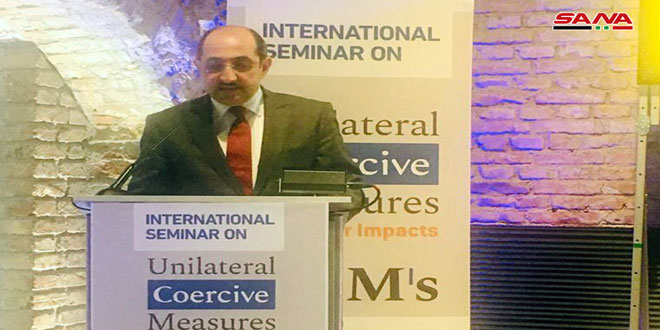
VIENNA, (ST)- The unilateral coercive measures imposed on Syria has badly affected the Syrian economy and led tens of thousands of Syrians to leave their country, Syria’s Permanent Representative at the United Nations in Vienna Bassam al-Sabbagh has underscored, pointing out that these measures constitute a blatant violation of the UN Charter and the resolutions of the UN General Assembly, Security Council and Human Rights Council which all prohibits imposing unilateral sanctions on other countries.
He made the remarks during the opening ceremony of the “International Seminar on the Unilateral Coercive Measures and Their Impacts” organized in Vienna jointly by the permanent missions of Cuba, Iran and Venezuela.
In a statement, Sabbagh said that Syria has suffered since the eighties of last century from different unilateral measures imposed by the United States. This suffering has doubled several times since 2011 and after the imposing of coercive measures by the European Union, the United States and some other countries, he added.
 Sabbagh went on to say that the coercive measures imposed on Syria also have had bad impacts on vital sectors like education, transport , agriculture, services, health and energy and on the Syrians’ ability to get their basic needs.
He pointed out that the Syrian government has adopted the strategy of enhancing the south-south cooperation and boosting trade and economic ties with its partners in the Russian Federation, China and Iran and other friendly countries.
Concluding his statement, Sabbagh reiterated the need to immediately lift these inhuman measures as they hinder the process of reconstructing what terrorism has destroyed, particularly schools, hospitals and other public facilities.
Venezuelan Foreign Minister Jorge Arreaza, Iran’s Assistant Foreign Minister for Political Affairs Abbas Arachi and several diplomats and independent experts took part in the symposium.
Hamda Mustafa