
Warning over suntan lotion application
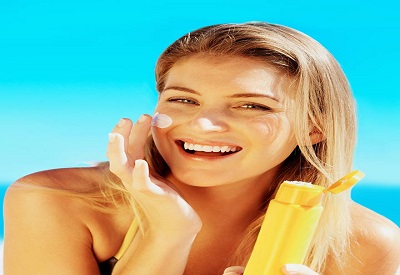
People are getting less than half the sun protection they expect from suntan lotions, according to research.
But the problem isn’t the lotion, it’s our slapdash application of it, King’s College London scientists say, according to BBC.
In theory, using sun protection factor (SPF) 15 sunscreen should be enough to stop sun damage.
But in reality, people need SPF 30 or 50 to be safe, say the study authors, who carried out experiments with volunteers in their lab.
Factor 50 lotion applied in the typical way would, at best, provide 40% of the expected protection, lead researcher Prof Anthony Young says.
His team measured how much protection people got from wearing different amounts of suntan lotions with varying SPF strengths.
– How does sunscreen work?
– Water-resistant sunscreen claims ‘meaningless’
– Suntans on children ‘are not healthy’
How to apply it
Sunscreen needs to be applied thickly enough, which many of us fail to do.
SPF ratings are based on the assumption that a 2mg blob will cover 1 sq cm of skin.
That means you should apply at least six full teaspoons (36g) to cover the body of an average adult.
More than half a teaspoon to:
Each arm
The face, neck and ears
More than one teaspoon to:
Each leg
Chest and abdomen
Back
Areas such as the sides of the neck, temples and ears are commonly missed, so take extra care and apply liberally.
It is also easy to forget to reapply sunscreen as often as necessary.
The British Association of Dermatologists advises:
– Put it on 15 to 30 minutes before going out in the sun, to allow it to dry
-Top up again shortly after heading outdoors, to cover any missed patches and ensure you’re wearing a sufficient layer
-Reapply at least every two hours and immediately after swimming or if it has rubbed off
Some lotions say they are water resistant, meaning they retain some sun protection properties after immersion.
However, up to 85% of a product can be removed by towel drying, so you should reapply after swimming, sweating, or any other vigorous or abrasive activity.
Another important factor is the reflection of the Sun’s rays, which can greatly increase the power of the radiation: snow by up to 85% increase, sand by up to 17% and water by up to 5%.
People with fair skin that burns easily, many moles or freckles, red or fair hair and light-coloured eyes are most at risk of sun damage.
Sunscreens should not be used to stay outside longer or just to avoid more reliable protective measures such as clothing and shade
Nina Goad, of the British Association of Dermatologists, said: “This research demonstrates why it’s so important to choose an SPF of 30 or more.
“It also shows why we shouldn’t rely on sunscreen alone for sun protection, but we should also use clothing and shade.”
Public Health England advises people try to keep cool and take shelter.
“To beat the heat, try to keep out of the sun from 11:00 to 15:00, walk in the shade if you can, apply sunscreen and wear a hat if you have to go out in the heat,” it says.
“Also try to carry water with you when travelling.”
H.Z