
`Oumuamua gets a boost
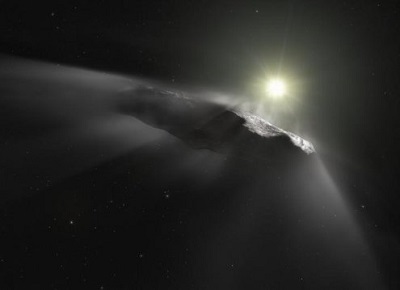
Oumuamua — the first interstellar object discovered within our Solar System — has been the subject of intense scrutiny since its discovery in October 2017 [1]. Now, by combining data from the ESO’s Very Large Telescope and other observatories, an international team of astronomers has found that the object is moving faster than predicted. The measured gain in speed is tiny and `Oumuamua is still slowing down because of the pull of the Sun — just not as fast as predicted by celestial mechanics, according to Science Daily.
The team, led by Marco Micheli (European Space Agency) explored several scenarios to explain the faster-than-predicted speed of this peculiar interstellar visitor. The most likely explanation is that `Oumuamua is venting material from its surface due to solar heating — a behaviour known as outgassing [2]. The thrust from this ejected material is thought to provide the small but steady push that is sending `Oumuamua hurtling out of the Solar System faster than expected — as of 1 June 2018 it is traveling at roughly 114,000 kilometres per hour.
Such outgassing is a behaviour typical for comets and contradicts the previous classification of `Oumuamua as an interstellar asteroid. “We think this is a tiny, weird comet,” commented Marco Micheli. “We can see in the data that its boost is getting smaller the farther away it travels from the Sun, which is typical for comets.”
Usually, when comets are warmed by the Sun they eject dust and gas, which form a cloud of material — called a coma (cometary) — around them, as well as the characteristic tail . However, the research team could not detect any visual evidence of outgassing.
“We did not see any dust, coma, or tail, which is unusual,” explained co-author Karen Meech of the University of Hawaii, USA. Meech led the discovery team’s characterisation of `Oumuamua in 2017. “We think that ‘Oumuamua may vent unusually large, coarse dust grains.”
The team speculated that perhaps the small dust grains adorning the surface of most comets eroded during `Oumuamua’s journey through interstellar space, with only larger dust grains remaining. Though a cloud of these larger particles would not be bright enough to be detected, it would explain the unexpected change to ‘Oumuamua’s speed.
Not only is `Oumuamua’s hypothesised outgassing an unsolved mystery, but also its interstellar origin. The team originally performed the new observations on `Oumuamua to exactly determine its path which would have probably allowed it to trace the object back to its parent star system. The new results means it will be more challenging to obtain this information.
“The true nature of this enigmatic interstellar nomad may remain a mystery,” concluded team member Olivier Hainaut, an astronomer at ESO. “`Oumuamua’s recently-detected gain in speed makes it more difficult to be able to trace the path it took from its extrasolar home star.”
Notes
[1]`Oumuamua, pronounced “oh-MOO-ah-MOO-ah,” was first discovered using the Pan-STARRS telescope at the Haleakala Observatory, Hawaii. Its name means “scout” in Hawaiian, and reflects its nature as the first known object of interstellar origin to have entered the Solar System. The original observations indicated it was an elongated, tiny object whose colour were similar to that of a comet.
[2] The team tested several hypothesis to explain the unexpected change in speed. They analysed if solar radiation pressure, the Yarkovsky effect, or friction-like effects could explain the observations. It was also checked if the gain in speed could have been caused by an impulse event (such as a collision), by `Oumuamua being a binary object or by `Oumuamua being a magnetised object. The unlikely theory that `Oumuamua is an interstellar spaceship was also rejected: the facts that the smooth and continuous change in speed is not typical for thrusters and that the object is tumbling on all three axis speak against it being an artificial object.
N.H.Kh