
Recent Events in Syria Demonstrated That Not Everyone Wants Peace – Lavrov
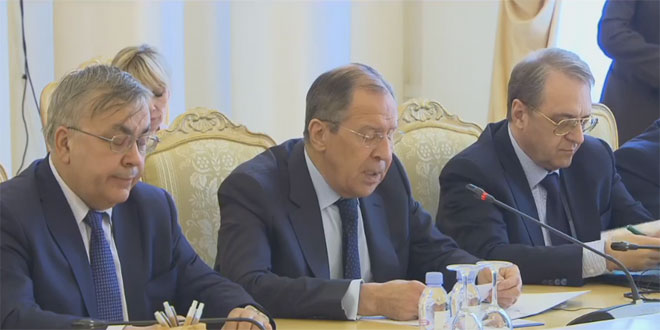
Sergei Lavrov, Mohammad Javad Zarif and Mevlut Cavusoglu, the foreign ministers of Russia, Iran and Turkey respectively, held a press conference in Moscow on April 28 to give their views on a number of international and regional issues including situation in Syria and the Iran nuclear deal.
Foreign Minister Lavrov pointed out that the US, French and British coalition airstrikes against Syria on April 14 were conducted before the OPCW completed its investigation into the alleged chemical attack in Douma on April 7, Sputnik reported.
The Russian foreign minister pointed out that cooperation between Russia, Iran and Turkey had helped Syria significantly in its struggle against Daesh (ISIS), the Nusra Front and other terrorist group.
Lavrov emphasized that peace efforts should not be accompanied by preconditions, such as the resignation of the Syrian government.
The foreign minister said Saturday’s talks will help consolidate further the efforts to abide by Resolution 2254 of the UN Security Council calling for a ceasefire and political settlement in Syria.
Lavrov emphasized that the UN can play a major role in helping the Astana process develop in several key areas. This includes a ceasefire regime in the so-called deescalation zones (which excludes terrorists). Lavrov urged armed opposition groups to drive terrorists out of these areas. The UN can play a role in making clear to the opposition not to make alliances with these “jihadist” groups.
Secondly, he said, the UN can assist in organizing a major campaign to help Syrians return to normal life, including via its humanitarian agencies.
Thirdly, the UN can help in facilitating political dialogue. The Astana process, culminating in the Sochi conference, achieved more than any other process, and formed the principles of Syrian settlement which were then presented to the UN.
Ultimately, Lavrov noted that Staffan de Mistura’s criticism of Astana and Sochi has been the result of pressure, and was odd given what these platforms have achieved. The Sochi declaration remains the main instrument for de Mistura to implement his mandate on Syria under UN Resolution 2254, he said.
For his part, Iranian Foreign Minister Zarif voiced his hope that the Astana process was the only one that could result in lasting peace in Syria. There was no military solution to the Syrian crisis, he said.
Zarif pointed to the upcoming Astana summit in May to discuss political issues, including the exchange of prisoners.
 The Iranian foreign minister also stressed that Tehran condemns the use of such weapons, and hopes that an objective investigation on the ground in Syria by the OPCW will find out the truth.
Zarif stressed that the global community has a responsibility to assist Syria, which has successfully fought against the terrorist groups such as Daesh (ISIS) and al-Nusra, in reconstruction efforts.
The Iranian foreign minister accused the United States of sowing discord between various factions and groups in Syria. US policy is counterproductive, he said, and has helped to further spread extremism in the region, from Iraq to Afghanistan.
Zarif said that President Trump’s demands regarding the Iran nuclear deal were a violation of Washington’s international obligations, and that US demands to change the deal were “unacceptable” for the Iranian people.
For his part, Foreign Minister Cavusoglu said that Saturday’s talks discussed a whole gamut of issues related to the crisis in Syria and the Astana peace process. He claimed Turkey’s support for Syria’s territorial integrity.
Cavusoglu said that the shared goal of the three guarantor countries was to provide Syrians with a normal life, to provide humanitarian aid, and ultimately to find a political solution to the crisis in Syria. The upcoming meeting in Astana will be “one more step” in solidifying the ceasefire and bringing peace to Syria, he added.
The foreign minister admitted that there have been efforts to undermine the Astana talks by “some groups.” He emphasized that the guarantors will continue their work, continue their cooperation, and making efforts at increasing such cooperation.
Russia, Turkey and Iran need to work together to help Syria eliminate terrorists
Ahead of the press conference, Lavrov said that Moscow believes that collective measures were necessary in the Astana peace talks format to normalize the situation in Syria. He also reiterated that Russia, Turkey and Iran need to work together to help Damascus clear the country of terrorists.
He reiterated that Moscow will continue to support the Syrian people in the fight against terrorism.
The Russian foreign minister added that unfortunately, “the events of recent weeks have shown that not everyone seems to want peace in Syria.
Iranian Foreign Minister Zarif said that the Astana platform for Syrian settlement was “the only initiative where Tehran cooperates with its Turkish partners, and this cooperation yields results.”
He made it clear that counter-terrorism is a global responsibility and that there is no military solution to the crisis in Syria.
He also said that the United States behavior in Syria causes escalation of tension and threatens the country’s independence and security.
He affirmed the need to conduct an inclusive independent investigation into allegations of chemical weapon use in Syria’s Douma.
He stressed Moscow and Tehran have reached a high level of understanding not only in security, but the economy as well.
Lavrov, according to Itar Tass, said that Western countries are making statements on the support for Syria’s sovereignty, independence and territorial integrity as a cover for their plans to reformat the Middle East and ruin the Arab republic.
“For Western countries, the statements in support of the sovereignty, independence and the territorial integrity of the Syrian Arab Republic are just words, which to all appearances are intended to cover up the plans for re-formatting the Middle East and dividing Syria into parts,” Russia’s top diplomat said.
“I am confident that Russia, Turkey and Iran, while confirming our support for the fundamental principles of the UN Charter, sincerely want the Syrian Arab Republic to remain a unified state, in which all ethnic and confessional groups will get equal rights and will be able to live in peace among themselves and with all their neighbors,” Russia’s top diplomat said.
H.M