
New Caledonian crows extract prey faster with complex hooked tools
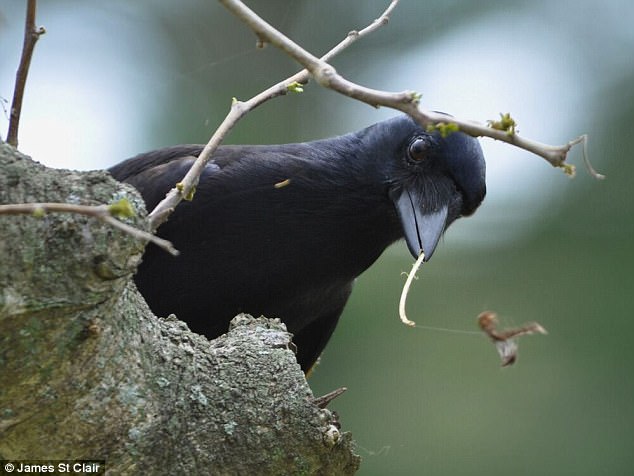
Biologists have discovered why some crows ‘craft’ elaborate hooked tools out of branched twigs according to Science daily.
The new study explores why crows go the extra mile rather than using simple, unmodified sticks to extract prey — it allows them to get at hidden food several times faster than if they used basic (non-hooked) tools.
New Caledonian crows are famous for their use of tools to winkle beetle grubs and other small prey out of hiding places. Although crows are capable of extracting food with straight twigs, in some areas they actively manufacture hooked stick tools before going hunting.
“It’s a painstaking sequence of behaviours,” explains lead author Dr James St Clair. “Crows seek out particular plant species, harvest a forked twig, and then — firmly holding it underfoot — carve, nibble and peel its tip, until it has a neat little hook.”
Biologists have long assumed that there was some benefit to crows manufacturing hooked tools, but had no idea just how much better they might be. The team conducted experiments to record how long wild-caught crows took to extract food from a range of naturalistic tasks, using either hooked or non-hooked tool designs.
Depending on the task, they found that hooked tools were between two and ten times more efficient than non-hooked tools. “That’s a huge difference!” says project leader, Professor Christian Rutz. “Our results highlight that even relatively small changes to tool designs can significantly boost foraging performance.”
These new findings help explain why New Caledonian crows have evolved such remarkable tool-making abilities: “In nature, getting food quickly means that birds have more time and energy for reproduction and steering clear of predators. It’s really exciting that we were able to measure the benefits of these nifty crow tools,” adds study co-author Professor Nick Colegrave.
Scientists still don’t know how crows acquire the ‘know-how’ and make hooks; they may inherit the ability from their parents, or learn by observing experienced birds. Either way, because hooked-tool users will live longer and leave more offspring, the skill is expected to spread.
Professor Rutz notes wryly: “We’ve all heard that the early bird gets the worm. In the case of the New Caledonian crow, it’s the skilled hook-maker that gets the worm, or at least it gets many more worms than its less-crafty neighbours!”
N.H.Kh