
Four Palestinians Killed during al-Aqsa Mosque Rallies
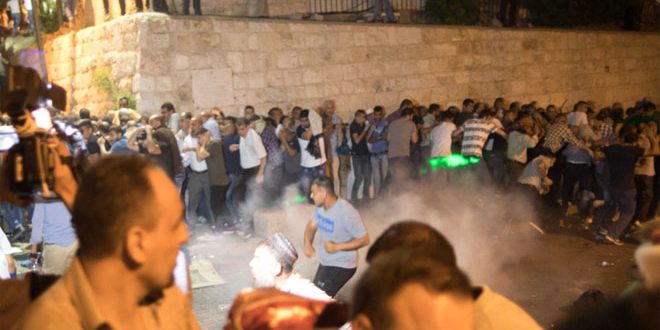
At least four people have reportedly lost their lives during clashes in the occupied Palestinian lands as tensions remain high there in the wake of the Tel Aviv regime’s crackdown on Palestinian worshipers wishing to pray at the al-Aqsa Mosque compound, according to Press TV.
Israel is preventing Palestinian men under the age of 50 from entering the compound, including Haram al-Sharif.
Israel fully closed off the compound to Muslims after a reported shootout on July 14 near the site that left two Israeli soldiers and three Palestinians dead. The move sparked far-and-wide condemnations across the Muslim world.
It restored access to the compound later, but placed metal detectors at its front, prompting Muslims to refuse to reach the site and hold prayers outside in a show of protest.
Palestinian medical sources and witnesses, speaking on condition of anonymity, said a Palestinian teenager, identified as 17-year-old Muhammad Mahmoud Sharaf from the Palestinian neighborhood of Silwan on the outskirts of the Old City of Jerusalem al-Quds, was fatally shot in Ras al-Amud neighborhood of East Jerusalem al-Quds on Friday afternoon, Arabic-language Ma’an news agency reported.
Witnesses said Sharaf was shot in the neck by an Israeli settler, and later succumbed to his wounds.
Participants in Sharaf’s funeral chanted slogans in memory of the teenager, and in support of al-Aqsa Mosque.
Sharaf’s death came on the same day that a seven-year-old boy, whose identity was not immediately known, died after inhaling poisonous gas used by Israeli forces to suppress a demonstration in al-Ramm town northeast of Jerusalem al-Quds, Lebanon’s al-Mayadeen TV channel reported.
Elsewhere, in the East Jerusalem al-Quds neighborhood of At-Tur, located approximately one kilometers east of the Old City of Jerusalem al-Quds, an Israeli settler shot and killed a young Palestinian man.
The Palestinian was identified by medical sources as 20-year-old Muhammad Abu Ghanam. He was a sophomore at Birzeit University.
Later on Friday afternoon, the Palestinian Ministry of Health said another Palestinian succumbed to his wounds at a hospital in Ramallah after having been shot in the chest by Israeli forces during a demonstration in Abu Dis.
The International Committee of the Red Cross (ICRC) announced that about 380 Palestinians had been treated for injuries sustained during clashes with Israeli forces on Friday.
 Additionally, a number of Palestinian civilians were wounded when Israeli soldiers fired live and rubber-coated steel bullets in Qalandia checkpoint and Salahuddin Street in central Jerusalem al-Quds.
Israeli forces also cordoned off the road leading to Qalandia refugee camp and fired shots to disperse a crowd of worshipers who had gathered there. At least 15 worshipers sustained gunshot wounds as a result.
About 30 citizens were also struck with rubber bullets during clashes in the central West Bank city of Bethlehem, located about 10 kilometers (6.2 miles) south of Jerusalem al-Quds.
The occupied Palestinian territories have witnessed new tensions ever since Israeli forces introduced restrictions on the entry of Palestinian worshipers into the al-Aqsa Mosque compound in East Jerusalem al-Quds in August 2015.
More than 300 Palestinians have lost their lives at the hands of Israeli forces in the ongoing tensions since the beginning of October 2015.
Israel trying to remove Palestinian heritage
Catherine Shakdam, director of the Shafaqna Institute for Middle Eastern Studies from London commented on the new wave of tensions between Israelis and Palestinians.
She said that there is a clear attempt to erase the religious heritage in the Israeli-occupied Palestinian territories.
Israel is trying to “deny Palestinian heritage”, claiming that the al-Aqsa Mosque belongs to the Zionists, the commentator said on Thursday night.
According to Shakdam, the Israeli regime is trying to “exacerbate hatred and divisions” within religious communities.
She went on to say that the standoff between the Israeli regime and the Palestinian people has its roots in denial of Palestinians’ political and cultural rights.
The Israeli regime is playing a very dangerous political game by defining people based on sectarian and ethnic lines under the pretext of protecting national security, Shakdam warned.
She pointed to Israel’s attempt to use terrorism as a weapon against Palestinians, noting that Tel Aviv has created the dynamics to generate violence.
The violent situation in the occupied lands of Palestine comes from the Israeli occupation and harsh tactics against the Palestinian people, she argued.
H.M