
Lavrentiev Discusses with Shamkhani, Jaberi Ansari Situation in Syria, Facilitating Political Dialogue to End Crisis
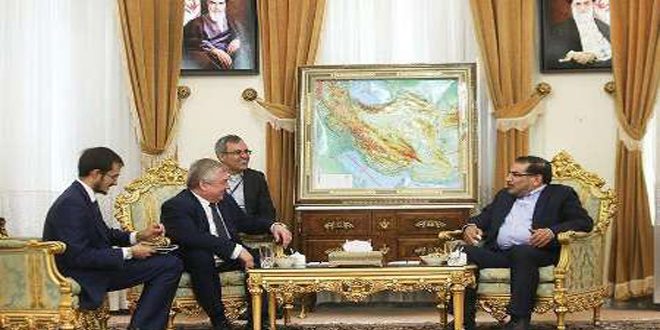
Tehran- Alexander Lavrentiev, Russian President Vladimir Putin’s Special envoy on Syria met on Thursday in Tehran with Ali Shamkhani, Secretary General of Iran’s Supreme National Security Council (SNSC).
The two discussed the latest developments regarding the crisis in Syria and stressed the importance of further political and field coordination in the Arab country.
Shamkhani is also Iran’s high representative for the coordination of joint political, military, and security activities with Syria and Russia.
According to Press TV,during the Thursday meeting with Lavrentiev, Shamkhani said that while Iran stressed the continuation of the fight against terrorism in Syria, it was also always committed to exploring a political solution to the conflict in the Arab country.
“We deem the military approach as effective only against those groups that refuse to lay down arms,” he said.
Iran, Russia, and Turkey, which together act as the guarantor states for the Syrian ceasefire, have also been organizing political talks between the Syrian sides in the Kazakh capital of Astana.
Shamkhani referred to those negotiations and said the “armed opposition” in Syria — which is a party to the Astana talks — should not be allowed to shrink from participating in the talks by inventing pretexts or as a result of incitement by certain countries opposed to peace.
The Iranian official also censured a recent US missile strike on a Syrian airfield and said the case of that violation of Syrian territory must be duly pursued.
Shamkhani said the US missile attack dimmed the prospect of reconciliation between Syrian sides and worked to encourage the terrorist groups in Syria.
He said an independent fact-finding mission had to be established to detect the paths through which chemical arms are delivered to the militants in Syria and in Iraq.
Elsewhere in his remarks, he said European countries, too, had to be concerned about the ongoing terrorism in Syria because, “like a dangerous virus, terrorism passes through borders and can’t be used instrumentally.”
Lavrentiev, for his part, commended Iran’s “constructive” role in the process of intra-Syrian talks but stressed Moscow’s commitment to militarily fighting those groups that shun the political process and continue to engage in armed activities.
He said Russia would however continue to work on the political channels on a parallel basis.
Need to Facilitate political dialogue
 Later in the day, Iranian Deputy Foreign Minister Hossein Jaber Ansari and Lavrentiev discussed the latest developments in Syria.
They focused on ways to fix the cessation of hostilities in Syria and facilitate political dialogue to end the crisis in Syria. They also talked about developments in the fight against terrorism.
The meeting comes within the framework of consultations and cooperation between Iran and Russia aiming to attain a solution to the crisis in Syria within the framework of Astana process.
Jaberi Ansari and Lavrentiev head the Iranian and Russian delegations at the Astana talks, respectively.
H.M