
Most habitable planets will be dominated by WATER that spans over 90% of their surface
When it comes to exploring exoplanets, astronauts may be wise to make sure their spacesuits are waterproof. According to Daily mail
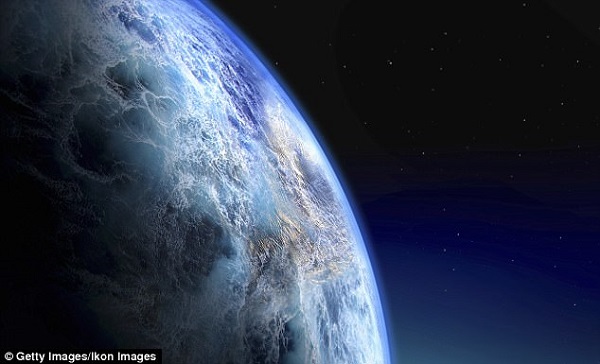
A new study has predicted that most habitable planets will be dominated by oceans that span over 90 per cent of their surface.
Researchers believe that the findings could provide clues to why we evolved on Earth, and not on one of the billions of other habitable worlds.
Researchers constructed a statistical model to predict the coverage of land and water on various exoplanets.
For a planet to have both land and water, a delicate balance must be struck between the volume of water it retains over time, and how much space it has to store it.
Both of these quantities vary substantially across the spectrum of water-bearing planets.
Until now, the reason why Earth’s values are so well balanced remained an unresolved mystery.
The researchers’ model predicts that most habitable planets have water that spans over 90 per cent of their surface area.
This result was reached because Earth itself is very close to being a ‘waterworld’ – where all land is immersed under a single ocean.
Dr Fergus Simpson, who led the study, said: ‘A scenario in which the Earth holds less water than most other habitable planets would be consistent with results from simulations, and could help explain why some planets have been found to be a bit less dense than we expected.’
The researchers suggest that Earth’s finely balanced oceans may be a consequence of the ‘anthropic principle’ – a theory suggesting that the universe is constrained by the necessity to allow human existence.
Dr Simpson said: ‘Based on the Earth’s ocean coverage of 71 per cent, we find substantial evidence supporting the hypothesis that anthropic selection effects are at work.’
To create the statistical model, the researchers took feedback mechanisms into account, such as the deep water cycle, erosion and deposition.
They also used an approximation to determine the diminishing habitable land area for planets with little water, which are slowly turning into deserts.
The researchers hope their findings will help to explain why we evolved on Earth and not on another habitable planet.
Dr Simpson added: ‘Our understanding of the development of life may be far from complete, but it is not so dire that we must adhere to the conventional approximation that all habitable planets have an equal chance of hosting intelligent life.’
N.H.Kh