
Atmosphere found around Earth-like planet GJ 1132b
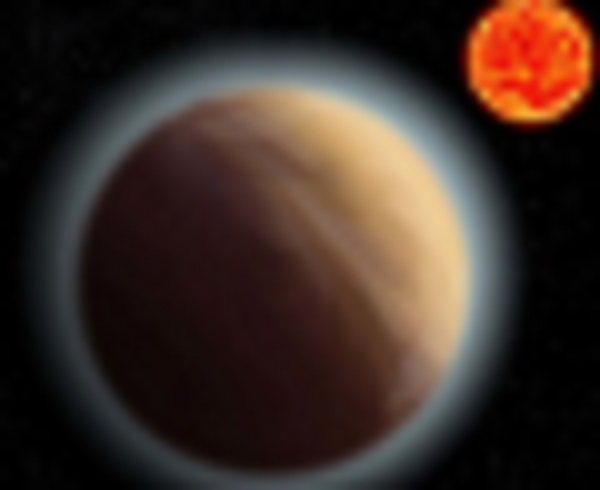
Scientists say they have detected an atmosphere around an Earth-like planet for the first time. According to BBC
They have studied a world known as GJ 1132b, which is 1.4-times the size of our planet and lies 39 light years away.
Their observations suggest that the “super-Earth” is cloaked in a thick layer of gases that are either water or methane or a mixture of both.
Discovering an atmosphere, and characterising it, is an important step forward in the hunt for life beyond our Solar System.
But it is highly unlikely that this world is habitable: it has a surface temperature of 370C.
Dr John Southworth, the lead researcher, said: “To my knowledge the hottest temperature that life has been able to survive on Earth is 120C and that’s far cooler than this planet.”
Chemical signatures
The discovery of planet GJ 1132b was first announced in 2015. It lies in the Vela constellation in the southern hemisphere.
One possibility is that it is a ‘water world’ with an atmosphere of hot steam
While it is a similar size to Earth, the star it orbits is much smaller, cooler and dimmer than our Sun.
Using a telescope, the researchers were able to study the planet by watching how it blocked some of the light of its host star as it passed in front of it.
“It makes the star look a little bit fainter – and it’s actually a very good way of finding transiting planets – it’s how this one was found,” said Dr Southworth.
But different molecules in a planet’s atmosphere – if it has one – absorb light in different ways, allowing scientists to look for their chemical signatures when the world transits its star.
The observations of planet GJ 1132b suggest that it has a thick atmosphere containing either steam and/or methane.
“One possibility is that it is a ‘water world’ with an atmosphere of hot steam,” said Dr Southworth.
The researchers say while it is unlikely that any life-forms could survive on this world, the discovery of an atmosphere is encouraging in the hunt for extraterrestrial life.
Dr Southworth said: “What we have shown is that planets around low mass stars can have atmospheres and because there are so many of those in the Universe, it makes it that much more likely that one might have life.”
Commenting on the research Marek Kukula, said: “This is a nice proof of concept.
“If the technology can detect an atmosphere today, then it bodes well for being able to detect and study the atmospheres of even more Earth-like planets in the not-too-distant future.”
N.H.Kh