
How desert ants find their way in a featureless environment
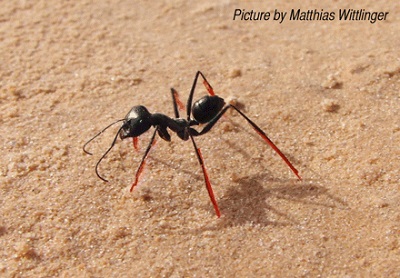
These desert ants live in salt pans and are ideal models for navigation research. When they set out in search of food in their flat, bare, hostile environment, they are nevertheless always able to find their way back to their nest on the shortest route possible. They have an internal navigation system. The ants measure the distance they have gone by recording how many steps they have taken — and they use the sun for directional orientation, taking into account its movement over time via their own internal clock. A team of researchers led by Dr. Matthias Wittlinger developed a tiny treadmill, on which the ants behave just as they do in the wild. “This gives us almost unlimited possibilities to test the mechanisms and neural basis of our model animal’s spatial orientation and navigation — in the laboratory,” says Wittlinger. “We can place the ants in a virtual world and incorporate certain changes into it to see how they react.”
The experiments are expected to yield information which will be useful in the development of autonomous robots as well as in other areas according to Science daily.
The ant treadmill is like a ball on top of which the insect can walk around, a bit like a hamster in a wheel. To the ant, it is like walking in its normal environment — although it doesn’t really go anywhere. The team developed the spherical treadmill in such a way that it enables the ant to walk using a natural gait, even when moving and changing direction quickly. The spherical treadmill contains optical sensors — like those in a computer mouse — which record precisely the ant’s direction and speed.
In the experiments the ant initially travels some ten meters from its nest — whether in the field or in the laboratory — storing information about the path it has taken. Then the researchers place it into the treadmill. The ant then moves exactly as it would if it were returning to its nest. It first heads back to the nest as directly as possible. Once it has arrived in the general area of the nest, the ant switches to search mode, taking a meandering path so as to find the exact location. The biologists have observed that the ants adapt their speed to the relevant phase of their journey — fast on the initial homeward trip, then slow in the searching phase. Comparisons between the virtual journey inside the treadmill and the necessary trip on the ground show that the insects have a high-precision navigation system.
N.H.Kh