
Zakharova: Moscow Hopes Astana Talks to Give Fresh Impetus to Syrian Settlement
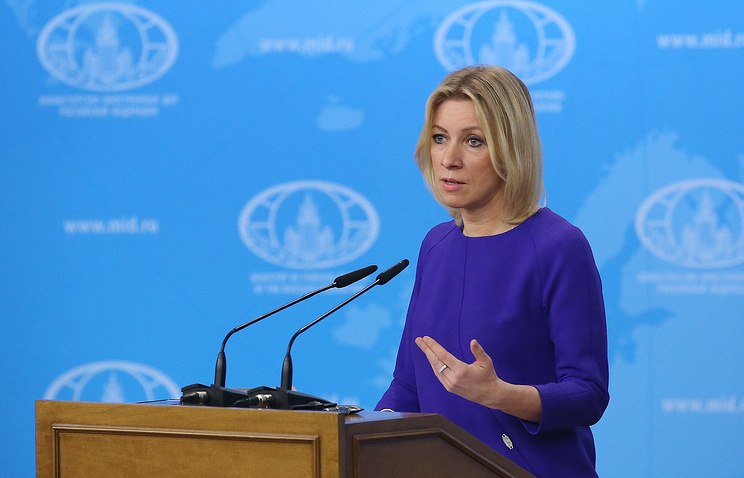
MOSCOW-Russia hopes that talks in Astana due on February 15-16 will give an impetus to the Syrian settlement process, Russian Foreign Ministry spokeswoman Maria Zakharova told a news briefing on Wednesday.
“A second international meeting on Syria is due in Astana these days,” Zakharova said. “I do hope that in the capital of Kazakhstan, where the Russian delegation has already arrived for working consultations due later today, an extra impetus will be given to an inclusive intra-Syrian dialog under the UN auspices in Geneva, which, we hope will be resumed in the last days of February.”
Defense Ministry: Astana meeting on Syria to be held on Feb. 15-16, no delays
According to the Russian Itar Tass News Agency, a high-ranking official of Russia’s Defense Ministry said talks on Syria in Kazakhstan’s Astana will be held on Wednesday and Thursday as scheduled, with no pauses or delays.
On February 15, the delegations will hold working meetings in a bilateral format to “specify positions and also voice the prepared proposals on ensuring ceasefire in Syria.”
“Tomorrow, a plenary session will be held here with the participation of all delegations where a final document may be agreed,” he said.
Earlier, Kazakhstan’s Foreign Ministry said that the meeting of the international group for settlement in Syria was postponed until Thursday.
On February 6, Astana hosted the first meeting of the joint group for monitoring ceasefire in Syria with experts from Russia, Turkey, Iran, the United Nations and Jordan taking part. The group was formed on the basis of results of a Syrian settlement conference held in Kazakhstan’s capital on January 23-24. The next meeting of the joint monitoring group is scheduled for February 15-16.
Media claims of chemical ‘attack’ by Damascus aim at fanning the conflict in Syria
Claims in the Western media that the Syrian government troops allegedly used chemical weapons in Aleppo are aimed at further fanning the crisis in Syria and exacerbating contradictions among the warring sides, Zakharova said.
“Only in this way it is possible to explain reports released in the media by Amnesty International, Human Rights Watch and, finally, the US Atlantic Council with the assistance of the CNN on the alleged instances of the use of chemical weapons by Syrian troops in Aleppo, mass executions in a military prison near Damascus and the purposeful destruction by the Russian air task force of the social and economic infrastructure in Syria,” the spokeswoman said.
“The evidential base of such so-called sensations leaves much to be desired but, as we see, this does not bother their authors much,” the diplomat said.
“The aim is to frustrate a chance for a turn towards peaceful political settlement that has appeared largely thanks to Russia’s efforts and disrupt the prospects that have opened up for the equitable and mutually respectful broad international interaction in the interests of eradicating the terrorist hotbed in the Middle East and stabilizing the region,” the spokeswoman said.
Indicatively, all these developments are taking place amid a campaign unfolding in the West for the struggle against the so-called fake news, the Russian diplomat said.
Terrorists might blow up residential areas in Palmyra
On Palmyra, the Russian diplomat said that besides targeting famous landmarks in Syria’s Palmyra by terrorist attacks, there is a threat that residential areas will be blown up too by the terrorists.
“Unfortunately, we can say that there is little left of the ancient architectural landmarks,” Zakharova added. “The terrorists have destroyed the front part of the ancient Roman Theater. Now, there is a threat that they will blow up the remains of the theater as well as the neighboring residential areas.”
H.M