
AlSwaidaa ..Geography and Administration
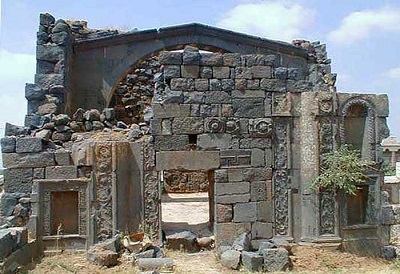
The governorate of alSwaida, known locally as Jabal al Arab was populated since the Stoneand the Bronze Age. Many civilizations flourished on its land leaving eternal monuments and edifices as witnesses on the greatness of these civilizations. AlSwaidaa city is the provincial capital of Jabal al Arab,105km south of Damascus.
In 88BC the Nabateans took it fromthe Greeks and made it one of their main headquarters and a center of worship to God Dozaris, god of wine and vineyards. In the thirdcentury B.C. the Romans made it one of their important cities. The Arab Ghassanids settled in it in the fifth century AD, and the Arab Moslems took in 634 AD. The cityhas many houses, castles, walls,towers, temples and cemeteries.Now alSwaida boasts a modernmuseum inaugurated in 1990,replacing an old one established in1923.
alSwaidaa governorate is located inthe south of Syria east of Daraa andnorth of Jordan. Administratively it is divided into three counties:alSwaida, the central city of the governorate,Salkhad and Shahaba. Eachone has several districts. The governoratehas an area of 5550 square km,with a rectangular shape of 120 kmlong and 66km wide.
The population of alSwaida is451578 people according to thecivil records of 2006,of which100.000 expatriates living in several countries of the world.
Climate of alSwaida is cold in winter,moderate in summer with a precipitationof 350-400mm. The governoratein generally mountainous, the city is1020m above sea level, Shahba is1050m ASL and Salkhad is 1125mASL. The highest point in the governorateis 1680m ASL. The area in generalis volcanic with black basaltstones.
alSwaidaa is famous for its vineyardsand apple orchards, in addition toolive groves and field crops: Wheat, barley, lentil and check peas.It has several traditional handicrafts,kelims, rugs, and straw trays.Molasses is one of the main agriculturalproducts. Certain industriesflourished in the city: carpets, shoesand wine.
The governorate has several cultural centers and societies as wellas various restaurants and hotels.

Shahba..
Shahba is one of the oldest cities in the governorate of alSwaidaa, 9o km south of Damascus and 19km north of thecity of alSwaida. It was inhabited by prehistoric man in the Stone and Bronze Ages. Flint tools: files, saws, bayonetsand spears were found in the hills surrounding the city. Arab Nabateans ruled it in 88BC after al fierce battle with the Seleucids in Motto (near Qanawat).This battle ended by killing the Seleucid King Antiochus XIII, leavingthe whole mountain to the Nabateans. Shahba, under the Nabateans became the main commercial center of the province although they left no great monuments behind them.
In 64AD the Romans, under Pompei, captured Syria, but Shahba was not of interest to them until one of its native citizens Philip the Arab was crowned emperor in Rome. Between 224 and 249 AD.Because it was his nativecity, he rebuilt it along the Roman style of civil engineering, named it Philip popolis after him, and built several mansions,temples, baths, awall, a smalltheater, acemeteryand anarch of triumph.
During the Roman period Shahbabecame one of the Decapolises,acquired the title of a province and coins were minted in it.
Shahba, now, is one of the maintourist attractions in Syria. It has aRoman temple, a kalype, a theater,baths, walls, gates, a Tetrapylon and the remains of a Byzantine church aswell as a museum, which original lywas a Roman palace with many mosaic panels on the floors of its rooms.
The temple: It belongs to Emperor Philip’s time, only 50m west of theTetrapylon with only three Corinthian columns still standing.The Kalype: A sanctified palace especially built as a residence for gods. In Greek it means a cottage built for shepherds or mermaids, or may be agod residence. There are severalkalypes in the region Shahba’skalypeis the most famous.
The theater:
It is a relatively small Roman theater built in the south western side of Shahba, but it is a typical Roman one in terms of architecture and the beautiful arcades and basements. It is 24.5m in diameter.
The cemetery:
It is known as the Philipion, located between the theater and the kalype. It was built to accommodate Emperor
Theater of Shahba
Philip’s parents Merinos andUthasselia. On the faÁade there is aGreek dedication to God Marinusengraved on the base of a statue. Thegate of the cemetery is 5.5m high and3m wide with beautiful ornaments onit. There are four columns with Ioniccapitals around the building.
The baths:
The baths were built by EmperorPhilip in the eastern part of theDecumanus. They are made of threeparts: the Frigidaire, the tipidariumand the caldarium. The baths had alibrary, a reading hall, a sport hall, arestaurant and rooms for entertainment.Water was brought to the bathsfrom a village 11km far from Shahbathrough clay tubes.
The Walls:
Shahaba was surrounded by a square wall of 1.5km side with defensive towers on its corners. Most of the wall and towers were destroyed.
The Gates: Shahba had four gates at the wall built in the shape of aTetrapylon.
The Museum:
The museum was established in1963in the same place where four mosaic panels , decorating the floors of rooms in the governor’s palace were discovered. The palace was built in the late Roman period in the third century AD. The museum houses the head and foot of a statue of Philip as well as several mosaic panels discoveredon the floor of a Byzantinechurch in alSwaida and in otherplaces in the governorate.
On the southern wall of the main lobby of the museum there is a panelshowing Bacchus, God of wine holdinga glass of wine. Other panels werediscovered in four rooms of thepalace;
-The First room:a panel of Thalassa , Goddess of thesea with a star fish on her head.
-The second Room:a panel of the four seasons and gifts ofthe land, with the center decoratedwith Marion, Dionysius, God of wineand Arian, Baphos and Hercules.
-The Third Room:has the panel of Urphe, The famous violinist,son of Apollo, and grandson ofJupiter, with many animals aroundhim.
The Fourth Room:has a panel representing the birth ofAphrodite or Venus, emerging from alarge shell on the coast of Cyprus,borne by mermaids…….WILL BE CONTINUED
Haifaa Mafalani