
Japanese scientist wins Nobel medicine prize for cell recycling work
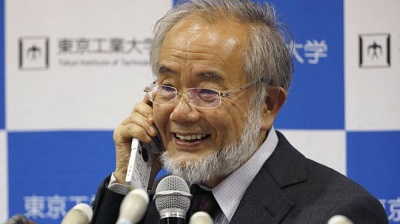
Apan’s Yoshinori Ohsumi won the 2016 Nobel prize for medicine for ground-breaking experiments with yeast which exposed a key mechanism in the body’s defenses where cells degrade and recycle their components.
Understanding the science behind the process, called “autophagy” or “self-eating”, has led to a better understanding of diseases such as cancer, Parkinson’s and type 2 diabetes, the prize committee said in its statement, according to Reuters.
“Ohsumi’s discoveries led to a new paradigm in our understanding of how the cell recycles its content,” it said.
The Physiology or Medicine prize, the first of the Nobel prizes awarded each year, is worth 8 million Swedish crowns ($933,000).
Ohsumi, born in 1945 in Fukuoka, Japan, has been a professor at the Tokyo Institute of Technology since 2009. He told Kyodo News agency he was “extremely honored” to get the prize.
In a separate interview with broadcaster NHK, he said he had “always wanted to do something that other people wouldn’t do”.
I thought the breakdown (of cells) would be interesting, and that was my start,” he said.
Ohsumi’s work – carried out in the 1990s and described by commentators as “paradigm-shifting” and “pioneering” – included locating the genes that regulate autophagy. This is important for medicine because it helps show why errors in these genes can contribute to a range of diseases.
David Rubinsztein, deputy director of Cambridge University’s Institute for Medical Research, said Ohsumi had provided scientists around the world with “critical tools” to help them understand how disrupted autophagy can contribute to illnesses including infectious diseases, cancers and neurodegenerative diseases such as Huntington’s and Parkinson’s.
Chister Hoog, a professor at Sweden’s Karolinska Institute, told Reuters the work helped explain crucial processes in human development, from growing up, to aging to succumbing to disease.
“In the very early stages (of a human’s development) your organs and your whole body is constantly being made over again – you are growing. So you need to get rid of the old stuff and generate new structures,” he said.
“When you undergo aging, you have structures that have to be taken away and this – autophagy – is the principle that gets rid of them.
“If you affect this system – the genes and proteins involved in autophagy – you no longer can take care of the waste, and once it accumulates you will get some type of disease.”
Prizes for achievements in science, literature and peace were first awarded in 1901 in accordance with the will of dynamite inventor and businessman Alfred Nobel. ($1 = 8.5776 Swedish crowns).
H.Z