
Zombie-ant fungus is under attack, research reveals
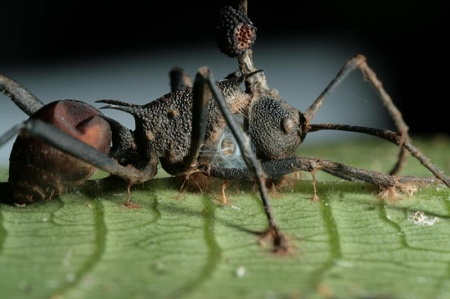
A parasite that fights the zombie-ant fungus has yielded some of its secrets to an international research team led by David Hughes. The research reveals, for the first time, how an entire ant colony is able to survive infestations by the zombie-ant fungus, which invades an ant’s brain and causes it to march to its death at a mass grave near the ant colony, where the fungus spores erupt out of the ant’s head. “In a case where biology is stranger than fiction, the parasite of the zombie-ant fungus is itself a fungus — a hyperparasitic fungus that specializes in attacking the parasite that turns the ants into zombies,” Hughes said.
“The hyperparasitic fungus effectively castrates the zombie-ant fungus so it cannot spread its spores,” said Hughes.
“Because the hyperparasitic fungi prevents the infected zombie-ant fungus from spreading spores, fewer of the ants will become zombies.”
As part of their research, the scientists created a detailed model that revealed previously unknown details of the interactions between the fungus-infected ants and the parasite-infected zombie-ant fungus. Scientists previously had known that ants defend their colonies against microscopic enemies such as fungal spores by efficiently grooming each other. In this study, the researchers also modeled the effect of ant behavior on limiting infection. “Interestingly, beyond the well known effect of defensive ant behavior, our new research may result in significantly limiting the spread of the zombie-ant fungus” Hughes said.
The scientists report that only about 6.5 percent of the spore-producing organs of the zombie-ant fungus were viable. “Even though there are a lot of dead and infected zombie ants in the neighborhood, only a few of the spores of the zombie-ant fungus will become mature and able to infect healthy ants,” Hughes said. “Our research indicates that the danger to the ant colony is much smaller than the high density of zombie-ant cadavers in the graveyard might suggest. This complex interaction between ant colonies, their brain-manipulating parasites, and other fungi capable of lending assistance to the colony underscores the need to study social insects under natural conditions.” Hughes said his team is expanding its efforts and “remains focused on following the exciting theatre played out on the rainforest floor.
Source:Science daily
N.H.Kh