
Snails make complex decisions using just TWO brain cells
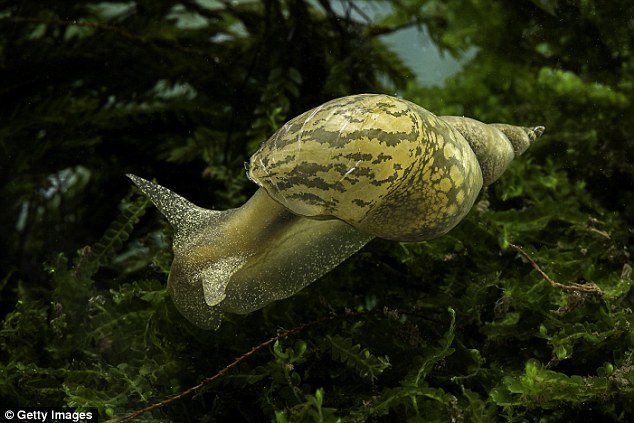
To eat or not to eat? That is the question facing fresh water snails when they come upon a morsel in their watery environments.
But while such a quick decision might seem beyond the snail’s pace, scientists have found that this complex decision-making process is dictated by a simple brain circuit, comprised of just two cells.
The first brain cell lets the mollusc know if food is available or not, while a second neuron tells the animal if it is hungry or not.
Scientists who made the discovery by monitoring fresh water snails on the hunt for food, and say their findings could potentially lead to developing more efficient robotic brains.
‘What goes on in our brains when we make complex behavioural decisions and carry them out is poorly understood,’ explained Professor George Kemenes, a neuroscientist who led the study.
Professor Kemenes added: ‘Our study reveals for the first-time how just two neurons can create a mechanism in an animal’s brain which drives and optimizes complex decision making tasks.
‘It also shows how this system helps to manage how much energy they use once they have made a decision.’
In order to test the snail’s decision-making; the researchers hooked up electrodes to monitor changes in activity in its brain, which picked up on spikes in the activity of individual neurons
They found that the two cells – a controller and a motivator – fed back to each other to make the decision. If food is present, the controller lets the animal know, and if the motivator says it is hungry, then the snail will nibble away.
But if food is not present, then the circuit can dial itself down, saving energy.
Seeking out food is a fundamental survival skill for animals and an example of goal-directed behaviour.
During these types of decision-making the animal must incorporate external information about their environment, with internal information about their state, in order to find food without wasting energy.
Professor Kemenes said: ‘Our findings can help scientists to identify other core neuronal systems which underlie similar decision making processes.
‘This will eventually help us design the ‘brains’ of robots based on the principle of using the fewest possible components necessary to perform complex tasks.’
He said: ‘The next phase of the research will be to develop the tools that will allow us to target specific neurons of the snail brain.’
Source: Daily mail
N.H.Kh