
How will we live in 100 years? Holidays to Mars, underwater cities
In Blade Runner and Minority Report, cities of the future are shown as threatening and intimidating places, despite the prevalence of incredible technology.
But life in 100 years’ time could be much more fun, with less time spent at work and holidays spent in drone-delivered ‘caravans’.
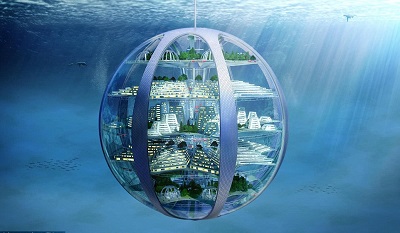
That’s according to a report that also speculates we may live in super skyscrapers or in underwater bubbles filled with smart and flexible furniture, as well as enjoying a three-day working week.
The Smart Things Future Living Report, authored by space scientist Dr Maggie Aderin-Pocock, futurist architects Arthur Mamou-Mani and Toby Burgess and urbanists Linda Aitken and Els Leclerq, suggests the way we live, work and play will change beyond all recognition over the course of the next century.
The report’s predictions are based on the idea that cities will become even more packed with people as the global population grows, and the environment will change.
So architects will have to burrow deeper underground and build increasingly tall structures, to squeeze everyone in.
An accompanying illustration shows a futuristic skyline where high rise apartments dwarf s tallest building – The Shard.
The report says that the use of carbon nanotubes and diamond nanothreads will help engineers create towering megastructures far taller than today’s skyscrapers, while 25-storey buildings could be hidden underground.
Underwater cities are a popular feature in sci-fi films and could not only become a reality by 2116, but be built from water itself, to create breathable atmospheres as well as generating hydrogen fuel in the process.
Inside, they could be furnished with 3D printed furniture within smart walls that will space by changing shape to provide extra seats or shelves through a malleable 3D surface.
‘LED room surfaces will mean you won’t need to re-decorate your home, as walls, floors and ceilings will adapt to suit your mood,’ it says.
The kitchen will look completely different in a century’s time too.
Ovens will be replaced by printers, where users can download dishes by famous chefs and print a cordon-bleu banquet at the touch of a button.
Other professional expertise will be available in the home, in the form of robotic doctors.
Home ‘medi-pods’ will provide people with a digital diagnosis and supply medicine if needed.
Source: Daily Mail
N.H.Kh