
Open-Access Database will Help Water-Scarce Countries Get More Crop Per Drop
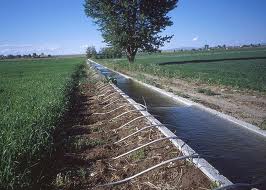
Rome – A new open-access data portal to be developed by FAO will use satellite imagery to help water-scarce countries in the Near East and North Africa better manage this precious resource.
Currently all countries in North Africa and the Near East suffer from severe water scarcity, with significant consequences for irrigated agriculture, the region’s largest water user.
This situation is expected to further intensify as climate change leads to more frequent and longer droughts, with severe impacts on food production.
The aim of the new data portal is to collect and analyze satellite information that can be used to improve land and water productivity and boost the sustainability of agricultural systems. All information will be openly available for countries and users who need it.
“Reporting on water productivity is lacking at country level in water scarce regions and this data will be key to creating sustainable agricultural systems in areas with scarce resources,” said Jippe Hoogeveen, project coordinator and technical officer in FAO’s Land and Water Division.
Remote sensing satellite images offer governments near real-time information regarding the use of natural resources for food growth and production, making assessments and improvements to existing agricultural practices more efficient and cost effective, he added.”
FAO presented the new project at the start of the annual World Water Week conference in Stockholm, Sweden (23-28 August).
Assessing productivity gaps, recipient countries
Remote sensing technologies have revolutionized the possibilities for assessing land and water productivity through greater coverage and data capture, however many countries lack the capacity and resources to analyze and work with this data.
The new database will be developed at three spatial scales: the continental level over the whole of Africa and Near East, country and river basin level and, irrigation scheme level. This will allow experts to cross check results at the various levels ensuring appropriate recommendations for improvements in different settings.
FAO technical support will include assisting countries in monitoring land and water productivity, identifying productivity gaps, proposing solutions to reduce these gaps and contributing to a sustainable increase in agricultural production.
“Advanced information and communication technology will play a crucial role in all of this work,” said Hoogeveen. “This information will empower those who need it, from SMS messaging for farmers working in water scarce areas to country experts using more sophisticated applications to assess information on water basin levels.”
The four-year project is being financed by the Government of the Netherlands and implemented by FAO in collaboration with the UNESCO-IHE Institute for Water Education and other partners. The development of the database is expected to begin in October 2015.
Growing global water use
Globally, water use has been growing at more than twice the rate of population increase for most of the last century, and an increasing number of regions are reaching the limit at which reliable water services can be delivered.
Today, agriculture uses 70 percent of all freshwater withdrawals worldwide and up to 95 percent in several developing countries.
Growing scarcity and competition for water stand as major threats to future food security and poverty alleviation, especially in rural areas. In semi-arid regions, increasing numbers of the rural poor see entitlement and access to water for food production, livestock and domestic purposes to be just as critical as access to primary health care and education.
By 2025, 1.8 billion people are expected to be living in countries or regions with “absolute” water scarcity, and two thirds of the world population could be under “stress” conditions.
Strategy, Awareness and Sustainable Development Goals
During World Water Week FAO is also making presentations on its various regional water scarcity initiatives.
The Organization is currently leading two projects related to monitoring progresses for the new
Sustainable Development Goals (SDG), including SDG 6 which concerns the world’s water resources.
“Monitoring water productivity will ultimately enable countries to report on an SDG target, which is of paramount importance in water scarce areas, but also globally,” noted Jean-Marc Faurès, FAO Senior Land and Water Officer.
Prepared By:
Sh. Kh