
Priorities for Women Issues_ Workshop
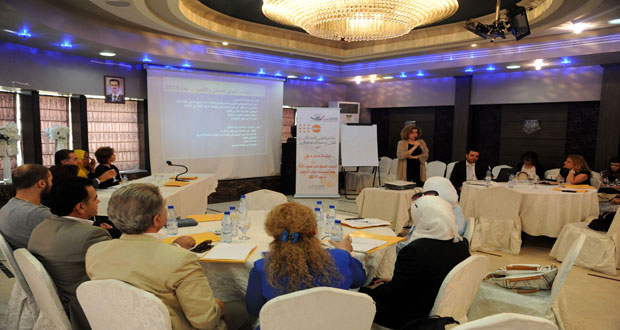
DAMASCUS, (ST) _ Participants in the workshop held by the Syrian Commission for Family Affairs and UNFPA (United Nations populations Fund) discussed yesterday Priorities for Action on women’s issues in accordance with recommendations of the Cairo Conference beyond 2014, at Damascus Blue Tower Hotel..
The participants stressed the need to launch community awareness campaigns so as to immunize women scientifically, culturally and intellectually as an essential component in society, arguing about social violence that emerged during the crisis, protection mechanisms and respond to women victims of violence.
The participants pointed the need to focus on social customs and traditions, especially in relation to women rights through involving women status and promotion of her economic, social and political reality by emphasizing the principle of gender equality mechanisms.
In opening speech, head of the Syrian commission for family affairs Hadeel al-Asmar stressed the key role played by civil society organizations to disseminate concepts of women’s rights and educating the community about it and expose the sexual crimes and their perpetrators.
She called for institutionalizing efforts to expand women’s participation in development and community building, noting the need for sustainable developmental programs, in a genuine partnership with gender issued advocating authorities in order to address hindering problems.
Asmar, noted that Syrian women proved to be the strongest despite the crisis experienced by the country by armed terrorist organizations which imposed in certain areas Wahhabi takfiri terrorist thought and prevented women from their right to education and practiced all forms of violence against women.
She also noted the commission’s programs and activities dedicated to improve services provided to eradicate terrorism devastating effects on the society especially on children and women.
For his part, Director of the commission’s population section Wadah al-Rakkad noted the most important indicators and gender gaps in employment and education, including women’s reproductive health.
The workshop was attended by representatives of concerned government authorities and civil societies.
Tomader Fateh