
Information Minister: Media of Resistance have strongly entered the battlefield
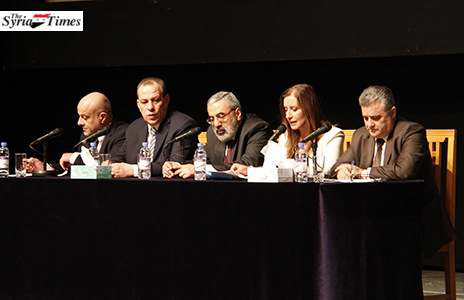
Information Minister Omran al-Zoubi stressed that the media of the resistance, including the Syrian media, have successfully managed to enter the battlefield with its modest capabilities, backed by a strong will and determination for survival and victory.
He was speaking during the second session on the second and last day of the International Media Conference Against Terrorism held in Damascus.
He referred to the state of confusion currently suffered by the tendentious and hostile media as they have been confronted by the media of the resistance that have highly contributed to exposing the disinformation practiced by the former about the nature of the terrorist war targeting Syria and the region, SANA reported.
Minister al-Zoubi highlighted the important role of the media of the resistance in confronting terrorism, referring to the need for further unmasking the true image of criminality and extremism under which Islamic State in Iraq and al-Sham (ISIS) and other terrorist organizations are operating.
“In order for our media not to lose their credibility,” said al-Zoubi, they must further focus on circulating pictures and materials that uncover the horribleness of the crimes committed by ISIS in challenge of the various media outlets that are acting as platforms for this and other terrorist and takfiri organizations.
The first session was held earlier today under the title of “the importance of media in military field task.”
Major General Osama Khaddour, Director of Political Administration, stressed the role of the Conference as a platform for developing the resistant media in confronting the aggressive terrorist war, which targets the Resistance Front in general and Syria in particular.
General Khaddour pointed out to the importance of the accuracy of the information in the military reporting, which comes at the expense of the speed.
He said that the Military Media Department has allowed media teams and missions from all around the world to visit areas of clashes throughout the past few years being messengers for conveying the reality of events taking place, adding that during 2014, 33 field visits were arranged to tour areas of clashes from 11 media outlets in coordination with Ministry of Information and the Directorate of Foreign Media, in addition to 13 visits from French, Danish , Spanish, Dutch, Swedish, Turkish media outlets as well as those from eastern Europe.
 “More other 26 visits from 12 media outlets from North and South American media outlets, 18 tours from 12 Russian outlets, in addition to delegations of journalists from Japan, China and tens of Arab and friendly channels were arranged”, Khaddour said, adding “this indicates the volume of work in covering war reporting.”
He reviewed the tasks of the military media in the Political Administration during the aggressive war on Syria, focusing on providing information for clarifying the developments in the military work against the terrorist organizations and highlighting the civil initiatives in support of the Army.
Khaddour pointed out to the role of military media in confronting the hostile media and combating propaganda it spreads, pointing out that one of the military media’s tasks is using leaflets- which have reached 30 million copies and hundreds of text messages, to citizens in the areas of military operations.
He also talked about the works of documentation carried out by military reporting regarding documenting the terrorist crimes, stressing the need for huge and rich archives to be a reference in the upcoming stages.
He presented a number of suggestions including spreading the legal culture on the optimum use of social media networks and coordinating the media policies among the media outlets to unify the discourse directed against terrorism and focus on highlighting the damage caused by terrorism on the state, the society and the individual.
He also stressed the need for enacting laws and legislations that prevent terrorists from using media outlets for spreading propagandas and lies.
For his part, Hezbollah Media Relations’ official, Mohammed Afif, said that the military media is used to affect armies of enemies and their audience, as it is also used for making a positive impact to encourage the fighters to be steadfast, considering that the psychological war is part of the military media efforts and it is a domain that requires specialized people, expertise and constant study and evaluation.
On the difficulties of this field of media, Afif clarified that this sort of media is closely linked to wars, army commanders, organizations and their political decisions, adding “here lies the dangerous overlapping between the overt and covert and this overlapping causes sometimes regulatory differences.”
He called for upgrading the media methods for attracting the public opinion and clarifying the full image in light of the expansion of the internet and the growing role of the social networking websites.
The two-day Conference kicked off its activities on Friday at the Opera House in Damascus with a speech by Information Minister, the representative of President Bashar al-Assad.

Ali Karimian, Secretary General of the Islamic Radio and Television Union also delivered a speech in the inauguration of the Conference.
Deputy Prime Minister, Foreign and Expatriates Minister Walid al-Moallem, Iran’s Culture and Islamic Guidance Minister Ali Jannati and Hezbollah Deputy Secretary General Sheikh Naim Qassem talked at the first session of the Conference which was held under “the title of the regional and international alliance against terrorism.”
In the second session, held under the title of “the role of media in the ongoing wars and the formation of the new world,” Presidential Political and Media Advisor Dr. Bouthaina Shaaban, in addition to a number of Arab and international media figures, delivered speeches.
Around 130 journalists from Russia, Iran, Cuba, Spain, China, Turkey, Afghanistan, Pakistan, Egypt, Lebanon, Iraq, Algeria, Morocco, Bahrain, Jordan, Saudi Arabia, Tunisia, Cyprus, Britain, Germany and Kuwait are participating in the two-day conference, in addition to Syrian journalists.
Discussions focus on the role of the national, friendly and hostile media in the political and intellectual discourse, the importance of military reporting, the role played by media in the ongoing wars, the formation of the new world and means of creating a regional and international alliance for countering terrorism.
The conference started by screening a film about the Syrian civilization and the high development rates in Syria before 2010.