
Zarif, Kerry Hold Talks Ahead of Deadline for Nuclear Negotiations
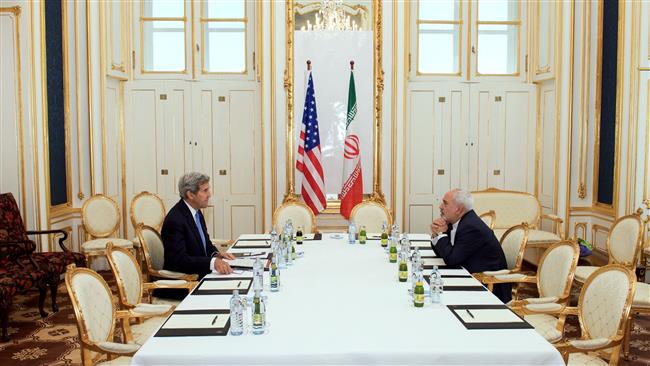
Iran’s Foreign Minister Mohammad JavadZarif and US Secretary of State John Kerry have held crucial talks ahead of the Monday deadline for the negotiations over Tehran’s nuclear program.
The top Iranian and US diplomats held a one-on-one meeting in the Austrian capital of Vienna on Sunday as hopes grew that an agreement will finally be in sight.
No talks extension – Zarif
Speaking after the meeting with his US counterpart, Zarif said there is no plan to extend the talks.
He added that the nuclear negotiators of Iran and the P5+1 countries have “still got work tomorrow.”
“No extension, we will finish hopefully. We need some more time. We need to do some more work,” the Iranian foreign minister said.
The Iranian deputy foreign ministers, Abbas Araqchi and MajidTakht-e Ravanchi, held several rounds of talks on Sunday with US Under Secretary of State for Political Affairs Wendy Sherman and Robert Maley of the US National Security Council on the text of a final deal and its annexes.
Iran and the five permanent members of the UN Security Council – the United States, Britain, France, Russia and China – plus Germany have been holding intensive talks over the past 16 days in the Austrian capital to iron out the remaining differences and nail down a landmark deal on Tehran’s nuclear program.

Iran nuclear talks in final stage – Fabius
French Foreign Minister Laurent Fabius says the marathon nuclear talks between Iran and the P5+1 group of countries are now in the final phase, amid signs of hope that a historic deal might finally be in sight.
“I hope we are finally entering the final phase of these marathon negotiations. I believe it,” Fabius told reporters in the Austrian capital of Vienna on Sunday.
Fabius added that he would attend meetings throughout the afternoon, including one with Director General of the International Atomic Energy Agency (IAEA) Yukiya Amano.
As the discussions entered a 16th day on Sunday, the talks appeared to be on the cusp of a landmark agreement.
Iran and the five permanent members of the UN Security Council – the US, Britain, France, China and Russia – plus Germany have been engaged in intense talks in Vienna to settle the remaining differences and sign a final comprehensive deal.
Following a Saturday meeting with Iran’s Foreign Minister Mohammad JavadZarif in Vienna, Fabius said the time is ripe for a decision in the tough nuclear talks.
“Everything is on the table. It’s now time to decide,” the French minister said.
Lavrov flying to Vienna
Russian Foreign Minister Sergei Lavrov on Sunday set off for Vienna to rejoin the nuclear talks, the Russian Foreign Ministry said on Twitter.
“Sergei Lavrov is flying out to Vienna to take part in the talks of the ‘six’ international mediators and Iran on the Iranian nuclear program,” the ministry said.
The Russian foreign minister and the US secretary of state had a phone conversation on Saturday on Kerry’s request.
Sergei Lavrov and John Kerry “continued discussing the course of the negotiations in Vienna on the work, on the agreement, (and) on the Iranian nuclear program.”
P5+1 meeting
Negotiators of the six countries held a meeting on Sunday without the presence of the Iranian negotiating team.
Simultaneous with the P5+1 meeting, the Iranian deputy foreign ministers, Abbas Araqchi and MajidTakht-e Ravanchi, sat down with US Under Secretary of State for Political Affairs Wendy Sherman. The Iranian deputy foreign ministers are likely to hold talks with European Union deputy foreign policy chief, Helga Schmid, later on Sunday.
Head of the Atomic Energy Organization of Iran Ali Akbar Salehi also held a short meeting with the IAEA chief on Sunday.

Iran deal will be ‘hard sell’ for Obama
On the other hand, US Senate Majority Leader Mitch McConnell says that President Barack Obama will have a hard time convincing Congress over a possible nuclear agreement with Iran.
“I know there will be a strong pull not to go against the president on something that is so important to him, but it is a very hard sell,” McConnell told Fox News on Sunday.
“We already know that it’s going to leave Iran as a threshold nuclear state, we know that,” he added.
The Republican senator also criticized Obama’s administration.
“It appears the administration’s approach to this is to enter in any agreement Iran will get into,” he said.
McConnell also opposed lifting of anti-Iran sanctions, claiming that Iran came to the negotiating table due to the sanctions.
“We could have ratcheted up the sanctions even further because that’s what brought to the table in the first place,” he stated.
PRESS T.V
R.S