
What Is Armenian Genocide Denial?
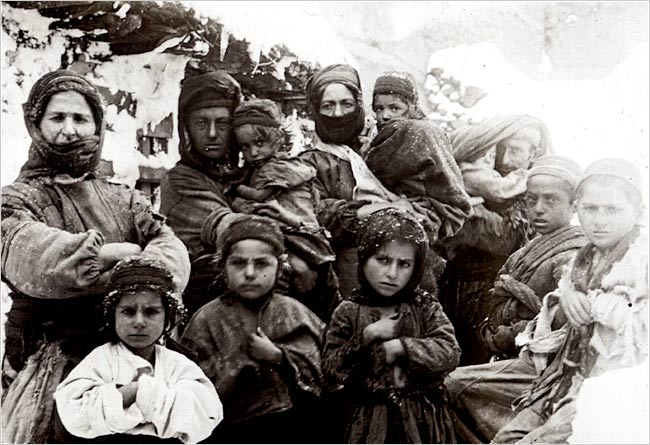
It’s been 100 years since the Armenian genocide began and Ottoman Turks started killing as many as 1.5 million Armenians over the course of several years, primarily in what is now eastern Turkey. The genocide is commemorated April 24 every year, but the descriptive term itself remains the subject of fierce controversy. Below are 10 key facts to know about the Armenian genocide, according to Elizabeth Whitman, the International Business Times:
1- Most estimates indicate between 600,000 and 1.5 million Armenians died at the hands of the Ottoman Turks from 1915 to 1918.
In an attempt to keep Armenian men from joining forces with the Russians during World War I, Ottoman authorities deported them to Iraq and Syria. Many starved to death or were killed.
2- The U.S. refuses to officially call it a genocide, out of deference to its ally Turkey. During his U.S. senate and presidential campaigns, President Barack Obama promised to use the word “genocide” to describe the mass killing. In 2008, he said, “The Armenian genocide is not an allegation, a personal opinion or a point of view, but rather a widely documented fact supported by an overwhelming body of historical evidence.” As president, however, Obama has yet to declare it a genocide.
3- A few U.S. politicians have proposed legislation or resolutions that would officially recognize the Armenian genocide as such, but Turkey has rejected these efforts. In 2014, the Senate Foreign Relations Committee adopted a resolution to label the massacre a genocide, and Turkey quickly condemned it. In March, four members of Congress also proposed legislation to recognize the genocide.
4- Turkey claims the number of deaths is exaggerated and that they came about not because of genocidal policies targeting Armenians but because of civil war. According to Agence France-Presse, Turkish President Recep Tayyip Erdogan has called for an impartial review of the events and said, “If the results actually reveal that we have committed a crime, if we have a price to pay, then as Turkey we would assess it and take the required steps.”
5- Armenians in the diaspora are hopeful that this could be the year Obama recognizes the genocide. Aram S. Hamparian, executive director of the Armenian National Committee of America, told the Los Angeles Times “very senior people in the White House” told him that the administration would thoroughly review the matter this year, for the first time since 2009.
6- The genocide is officially commemorated April 24, the date in 1915 when the Young Turks arrested about 200 leaders in the Armenian community and later executed them. The date is frequently marked with rallies and marches in Armenian communities around the world.
7- The modern-day Armenian diaspora is estimated to encompass 10 million people, and its members are scattered all over the world, from Europe to Asia to North America.
8- The dispute over the term “genocide” still plays out in courts. In January, attorney Amal Clooney, representing Armenia, faced off against Armenian genocide denier Dogu Perincek in the European Court of Human Rights. The court had overturned Perincek’s 2007 conviction for denying the genocide, on the grounds that it violated his right to free speech, and Armenia was appealing that decision.
9- When the genocide happened, it was largely condemned by the international community, but no country took action directly against the Ottoman Empire for the genocide. However, some governments sponsored reports to document what the Armenians had gone through.
10- Massacres of Armenians during the genocide didn’t occur in Turkey alone. Armenians were killed in Syria, as well.
M. Al-Ibrahim