
Jaafari: Syrian Government Fulfilled Obligations, Continues Providing Humanitarian Assistance
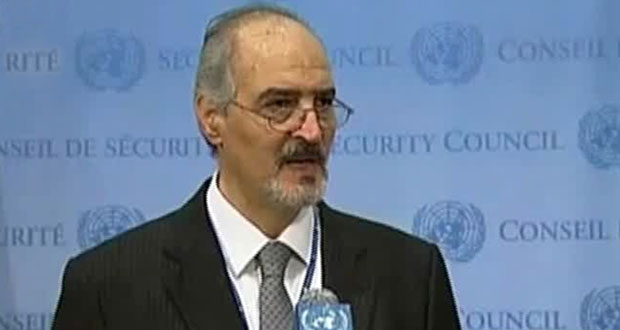
NEW YORK, (ST) _ Members of the UN Security Council adopted yesterday Resolution 2191, which renewed content of paragraphs 2 and 3 of UN resolution 2165 and focused mainly on the introduction of humanitarian aid to the Syrians, whether inside Syria through the response plan, in coordination with Syrian government and OCHA or by the so called the Troika of the UN Security Council ambassadors by cross-border operations.
In a statement on the said resolution, Syria’s Permanent Representative to the UN Dr. Bashar al-Jaafari said that the Syrian government has been a full partner continuously fulfill its obligations in the efforts to provide humanitarian assistance in all Syrian areas, noting that the 7th response plan will be signed between the Syrian government and OCHA very soon.
Jaafari pointed out that the ambassadors of Jordan, Luxemburg and Australia to the UN Security Council, who were behind the initiative of the adopted UN resolution, do not follow what is happening on the ground in Syria nor read reports to that the reason of impeding the introduction of cross-border aid is not the Syrian government, but the terrorists who are preventing the introduction and distribution of aid convoys.
Jaafari also indicated that the Turkish government prevents the use of OCHA staff of Nusaybin crossing to enter aid, while Daesh terrorists prevent its access through the crossings with Iraq, pointing out that these points were not mentioned by any side.
Jaafari noted a “ gentlemen” agreement between the Syrian government and members of the UN Security Council and the UN Secretary General, as an integral part of UN resolution 2165, which states that OCHA should notify the Syrian government in advance, 48 hours before sending a cross-border assistance, but Valerie Amos did not respect the agreement this since the first hours of its signature “.
He outlined reasons behind the malfunction of the humanitarian conditions in Syria to include terrorism phenomenon which is backed by some well-known countries, lack of cooperation by OCHA with the Syrian government and insistence on the introduction of aid across the border without prior coordination with the Syrian side and without the involvement of the Syrian Red Crescent, lack of funding for the 2014 plan, and imposition of unilateral coercive and illegitimate measures, which impact living situation of the Syrians and the inability of the Syrian government and the private sector to ensure citizens needs.
Replying a question about the impact of the so-called frozen areas on humanitarian aid, and why they were not included in the UN resolution, Jaafari explained that ” Staffan de Mistura track; is different entirely and is a political path,” adding that preliminary paragraphs preliminary of the said UN resolution did not include any reference to resolutions 2170 and 2178 and even de Mistura mission to which the note has been recently introduced as it was non-existent in the first version.
T. Fateh