
Agriculture Minister discusses with ACSAD ways to enhance joint cooperation
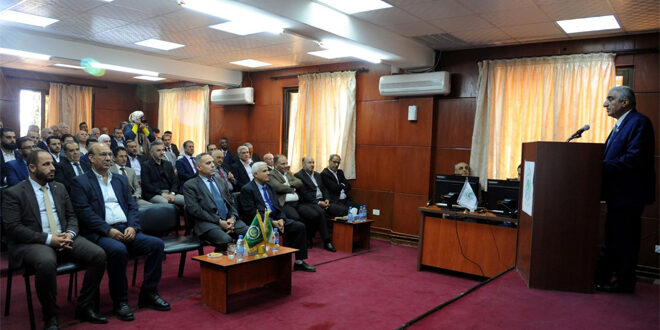
DAMASCUS, Apr.26, (ST)-Today, Minister of Agriculture Amjad Badr discussed with Nasreddine Al-Obeid, Director-General of the Arab Center for the Studies of Arid Zones and Dry Lands (ACSAD), ways to enhance and coordinate joint cooperation to address agricultural challenges and the negative impacts of climate change, and to find appropriate solutions to achieve sustainable development in Syria and Arab countries.
The Minister stated that Syria today needs to adopt a collaborative approach between the Ministry and ACSAD.
Bader affirmed the Ministry’s readiness to provide all necessary facilities to further enhance cooperation and achieve the desired results.
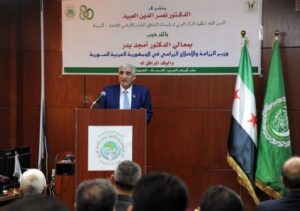 He indicated that plans will be developed based on priorities and the availability of resources between the two parties.
The minister added, “We are still at the beginning of the road, but everything related to the problems and obstacles facing the agricultural sector is taken into account and requires careful coordination.”
Regarding the Ministry’s vision, he said, “The vision exists, but work is underway to develop plans to mobilize efforts and describe the available resources and energies. However, we still have to determine the method of implementation and the tools we need, which are derived from our reality and from cooperation programs with friends.”
 He stressed the need to transfer pioneering experiences to farmers in Syrian fields, in cooperation with ACSAD staff, to achieve a true agricultural renaissance in the region.
For his part, Dr. Al-Obeid emphasized the readiness of ACSAD to enhance partnership and mutual cooperation in various areas of common interest, in a way that meets the vision and aspirations and strives to build a new, modern, and advanced Syria. This is achieved by presenting the organization’s accumulated expertise and research results, and applying its success stories in all agricultural fields to enhance food security.
Al-Obeid said, “We are trying to develop varieties of wheat and barley that do not require large quantities of water, because climate change, water scarcity, and the decline in per capita water share in the Arab region have significantly changed. In Syria, for example, the per capita share in the 1970s was approximately 3,000 cubic meters, and now it does not exceed 400 cubic meters per year. Therefore, we find that there are priorities that must be met, including the use of non-conventional water, brackish water, and seawater. Therefore, we must focus on agriculture, especially conservation agriculture, and, most importantly, make the most of every drop of rainwater to increase productivity.” He explained that one hectare of wheat requires 3,700 cubic meters of water, so we find the issue of water rationing very important.”
He added: We know that the agricultural sector in the Arab world consumes more than 85% of the water, and therefore increasing irrigation efficiency has become an urgent necessity. He pointed out that we have more than 100 billion liters of water wasted in the Arab region, so it must be made available for vertical and horizontal expansion in the agricultural sector.
Basma Qaddour