
Activities of Arab Wheat Conference are launched at “ACSAD” Center in Damascus countryside
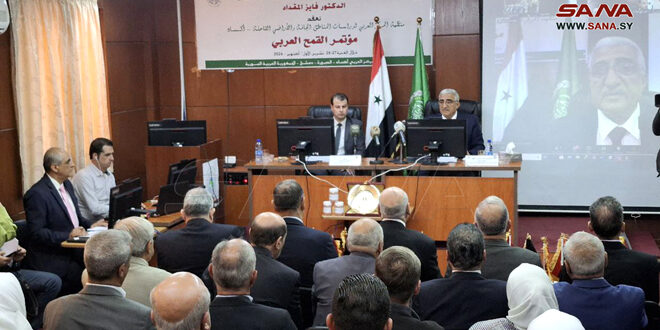
The activities of the Arab Wheat Conference were launched today at the Arab Center for the Studies of Arid and Dry Zones “ACSAD” in the countryside of Damascus, in cooperation with the Ministry of Agriculture and Agrarian Reform and with the participation of 13 Arab countries virtually via the Internet.
The conference, which continues until tomorrow, discusses the reality of the wheat crop in Arab countries and the future prospects for genetic improvement of wheat in the light of climate change. It also brings together a group of scientists from these countries to present a working paper that includes the reality of the wheat crop in terms of areas, production and cultifation, and discusses the challenges that stand in the way of developing this crop.
In his speech during the opening of the conference, Minister of Agriculture and Agrarian Reform Dr. Fayez Al-Miqdad stressed the ministry’s support for ACSAD and its activities in developing new types of wheat that are exported to all Arab countries, pointing to the importance of collaborative work and striving to achieve agricultural development despite major challenges. Minister Al-Miqdad explained that Syria has achieved self-sufficiency in wheat crops over many years, but the circumstances it has gone through in recent years have greatly affected this.
In turn, the Director General ACSAD, Dr. Nasr Al-Obeid, explained that the center has placed the issue of developing wheat production in the Arab world at the top of its priorities and work strategies, and its experts have succeeded in devising and developing 87 new varieties of wheat and barley that are characterized by high production qualities.
Al-Obeid pointed out the need to invest in the latent production capacities in Arab countries, especially in Sudan, Algeria, Iraq and Syria, which secure a production of no less than 15 million tons annually, which means approaching self-sufficiency in wheat in the Arab world.
According to Al-Obeid, ACSAD has implemented dozens of development and production projects, where it has provided many Arab countries with its distinguished varieties that aim to increase wheat production in Arab countries to cover the current deficit in production, and reduce the existing gap between the annual consumption of wheat in Arab countries, estimated at about 60 million tons, and the production that reaches 25 million tons annually, which forces Arab countries to import about 35 million tons every year, worth $10 billion.
Inas Abulkareem