
“Weaving a Tale of Silk and Gold: My Journey to Find the Perfect Damask Fabric in Syria”?
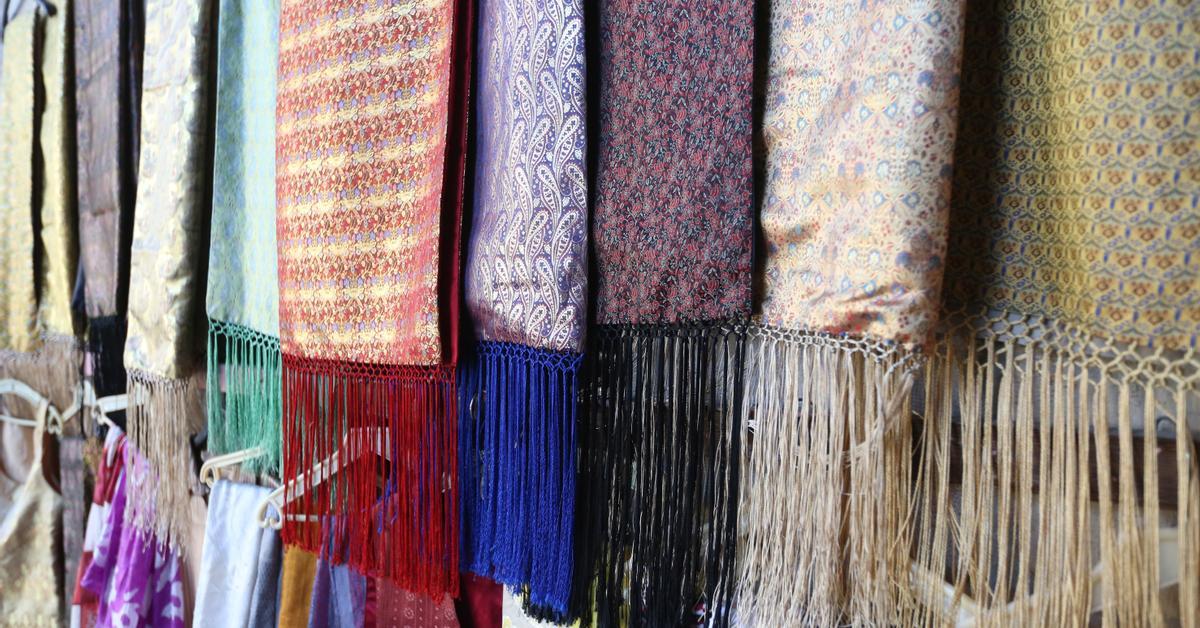
As I walked through the bustling Al-Hamadiyyah Souk in Damascus, Syria, I was struck by the vibrant colors and intricate patterns of the textiles on display. The souk is a labyrinth of narrow alleys and covered bazaars, filled with merchants hawking their goods and eager shoppers searching for the perfect fabric. The air was thick with the scent of spices and the sound of haggling voices. I was on a mission to find a Damask jacquard patterned fabric similar to the one used in my grandmother’s wedding dress.
The sentimental value of this fabric made it the perfect choice for my daughter’s wedding dress. As I navigated through the market, I encountered a myriad of colorful fabrics, each with its own unique pattern and texture. However, despite the wide variety of options, I was unable to find the exact Damask jacquard pattern I was seeking. It dawned on me that the intricate Damask fabric patterns are indeed rare, with only a dozen or so distinct designs available. Although I was unable to find the exact pattern I was looking for, the experience of immersing myself in the world of Damask fabrics and witnessing the craftsmanship firsthand left a lasting impression.
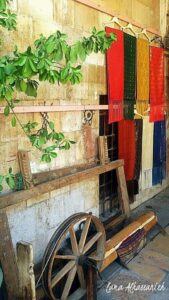 Damask is a reversible fabric that is known for its elegant sheen and reversible patterned effect. It is woven using a reversible technique, where contrasting weaves are used for the ground and patterned areas. This creates a distinct sheen and reflective quality, resulting in a sophisticated and elegant appearance. Damask fabric was originally hand-woven, often in silk, which helped to better reflect the light and create depth in the designs. This lent damask a reputation as a luxury fabric. What distinguishes this fabric from Chinese and Indian brocade is the importance of what it reflects in its engraving and drawing as damask contains geometric designs inspired by the Umayyad Mosque decoration including plant and animal motifs such as roses, hazelnuts and butterflies, but the most famous, is that of the “loving birds” according to merchants at the textile souk.
On the other hand, brocade is a heavy and thick fabric that is often used for formal garments and decorative purposes. It is woven by incorporating additional weft threads, often metallic or contrasting in color, to create raised patterns. This technique adds a textured and visually striking effect to the fabric. Whereas, Jacquard refers to the weaving technique that utilizes punched cards to control the loom and create intricate designs. This method allows for a wide range of patterns, from simple geometric shapes to complex pictorial scenes, making Jacquard fabrics highly versatile in terms of design possibilities. Fabrics made by this method include Brocade, Damask.
 An interesting coincidence that in the Syrian dialect, Damask is referred to as “Damascene Broquar” (ElBroquar ElDimachki), which is a combination of all three types of woven fabrics: Damask, Brocade, and Jacquard. This unique name reflects the rich history and cultural significance of Damask fabric in Syria.
As for the English name “Damask” is a patterned textile, which derives its name from the fine patterned fabrics produced in Damascus, Syria, during the European Middle Ages. Initially, true damask was wholly made of silk, but gradually the name came to be applied to a certain type of patterned fabric regardless of fiber. Damask weaving is believed to have originated in China around 300 B.C., but it developed into a major weaving technique during the early Middle Ages. The production of damask in the Middle Ages centered around Byzantine and the Middle East, headquartered in Damascus. Merchants and Crusaders who had passed through Damascus introduced the fabric to Europe in the 11th century.
Syria was one of the most important stations on the silk road, and its textile industry developed over the ages, reflecting the Western and Oriental influences in its designs and colors56. Silk was the main component of Syrian textiles for a long time, and some of them became famous, such as damask and brocade. However, since the last century, cotton cultivation in Syria has been growing and spreading, which has helped to grow the cotton spinning industry. The textile industry in Syria contributed 27% of the net non-oil industrial production in Syria and formed approximately 45% of non-oil exports in 2009. It also employed 30% of the total workforce in that year.
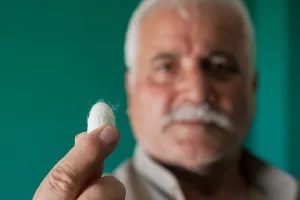
The long history of silk making in Syria was fascinating, especially how it intertwined with politics in ancient and modern times. There was no single ‘Syrian silk craft.’ What existed was a multitude of crafts and traditions, interlinked and dependent on each other. You needed the cocoons to make thread. You needed thread to weave or crochet fabric. The weavers sold the fabrics directly, or sent them to be dyed. Sometimes the thread was dyed first, and it always needed to be prepared for weaving. The processes were separate, and each had its different community of craftsmen and women, although some groups overlapped. What existed was a supply-chain.
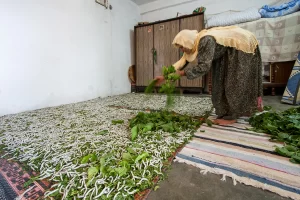
In 2009, there were 16 Syrian villages that reared silkworms. They produced two tons of cocoons, compared to 360 tons produced in the country in 1970. The whole family is engaged in the intense seasonal work. The worms are very delicate and react negatively to pesticides, cigarette smoke, perfume, and disease. When they are very small, the women finely chop mulberry leaves for them. When they reach their full sizes, the families sleep outside and give them the more comfortable quarters.
In parallel to the village-based activities, craftsmen in larger cities, such as Damascus, created exquisite damask and brocade fabrics with metallic and imported silk threads, using centuries-old designs. Dyers in Aleppo made simple silk fabric squares into symmetrical abstract expressions of white, red, and black dyes. Weavers in Homs and Hama created traditional striped textiles. Craftswomen produced knot-and-dye dresses that took days to make. Skilled merchants sold fabrics and negotiated prices with their equally-savvy customers. All of these activities are part of the larger picture of silk production in Syria.
 Damask fabric continues to be appreciated for its intricate patterns and luxurious feel. Its enduring popularity is a testament to the skill and craftsmanship of the artisans who have contributed to its rich history. However, Cultural heritages need to be protected at a time when the world is getting ever smaller, the sweeping force of consumerism is changing cultural attitudes, and tourism is becoming a major industry and a vital one for many communities. Material culture, present through arts and handcrafts, is an important asset that helps define who we are, and serves as a tool for stressing human commonalities and promoting understanding, respect, and appreciation between people who belong to different cultures and generations.
Lama Alhassanieh