
Syria the center of prehistoric civilization (1)
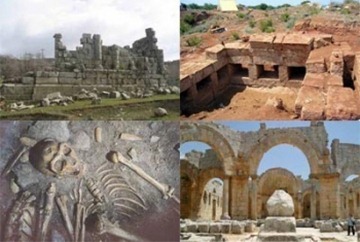
World news agencies were highly interested in the latest archaeological discoveries lately revealed by the Syrian-French excavation mission; which become the dominant subject of scientists and archeologists specialized in prehistoric eras especially that of the Neolithic age that witnessed the early development of agriculture and flying animals domestication. This epoch was characterized by the invention of several tools and large developments in various arenas, a matter that would change the future of humanity and upcoming civilizations. All those significant events took first place in Syria as early as the 9th millennium BC.
Archaeological missions excavating in Tal Al-Aswad hill, dating back to past century, found molded human skulls dyed in red with eyes holes filled with black tar, indicating evidence of certain funerary rites and ancient theological beliefs predating the 7th millennium BC.
Rites and beliefs related to our ancestors who had left behind several ancient agriculture tools like sickles, knives, arrows heads and charred grains; confirm that ancient inhabitants of the place had practiced agriculture and domesticated animals.
Archaeological studies and researches executed in several areas in and around Damascus confirmed that the period between the 8th and 9th millennium BC, was very rich as it witnessed significant human lifestyle alteration. For instance, leaving caves to found built villages and changing towards stable settlements in an established area. Those villages by themselves represented the great achievement of deliberate development of life principles in Syria before any other part in the world.
Moving towards an organized productive economy was a giant step in the history of humanity; it paved the way for later civilizations to progress and prosper, that why scientists called it the Neolithic revolution. Water abundance and land fertility in Damascus and around it, helped man to settle in that area since old ages. Therefore, technical and ideological development in ancient Syrian villages was accorded to villages like Al-Aswad, Al Rammeds, Al Mureibet, Baqrass’s and Abu Haere’s Hills. All excavations executed in the aforementioned sites confirm these facts.
Al-Aswad Hill in Damascus ghouta, is located in an area of swamps between two lakes, with superficies of 270×225 m. The site exploration and examination has proven that human settlement started between 7790 and 6690 BC. The site was proven to date back to the first Neolithic age which preceded pottery industry era, by means of comparing stone items and tools discovered in Al-Aswad Hill with discoveries of other sites. Moreover, the hill counted in a crowed quarter of round shaped houses full of ashes and burnt plants, having cylindrical silos that might had been used for storing grains. Houses were connected in most cases, evidences revealed that older houses were linked with newer ones.
Excavation found large numbers of bricks made of mud mixed with hay. Each brick has a flat bottom and a concave top with traces of human fingers; pieces of them were found burnt and charred among the ruins, in addition to well-arranged ones. 2006 discoveries proved that Al-Aswad Hill was a village of small round cottages built extensively near each other.
Mud was used to make low platforms, whereas the upper part of the cottage was built of light materials easy to catch fire, since findings showed that houses were burnt several times. It is also worth mentioning that the surrounding environment obliged the village dwellers to use light materials like reeds usually grow in sumps Lakes Utaibe and Hijaneh were rich in fish which used as the main food stuff.
(To be continued)
Haifaa Mafalani