
Syrian translator presents first translation of Argentine poetry into Arabic
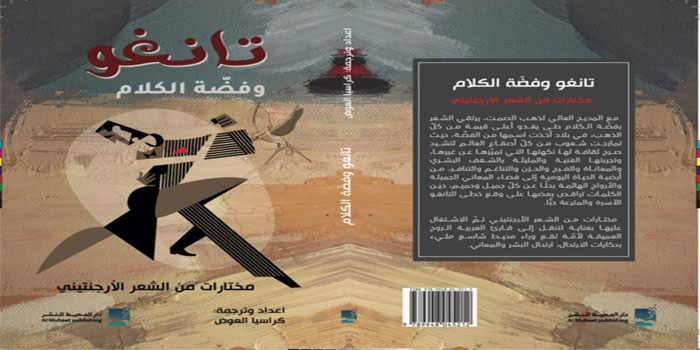
“Tango and the Silver of Speech”
This book “tango and the silver of speech” which was translated from Argentinian into Arabic by the expatriate Syrian poetess and journalist Krasiah Al- Awad,who has been living in Argentina for nearly a quarter of a century, was recently published by the Emirati Dar Al-Muheet,and It is the first translation of anthologies of Argentine poetry into Arabic.
How did this book come to life?
The translator (Krasiah-Al-Awad), tried as much as she could through this book to present a sample of poetic voices that embody the Argentinian poetic movement today, relying on objective taste while choosing the selections , as trying to encompass the entire poetic landscape is something that requires time and perhaps several books to present it.That’s what Al-Awad tried to indicate in her introduction by shedding light on a general historical ground that deals with an important part of the history of Argentine poetry as a kind of completion process for what no single work can accommodate , adding that the texts she to chose to translate, made her the best effort to transfer them from one language to another with the most honesty and sincerity, through the intuitive challenge of entering the secret worlds of the poetic text.
What can we expect from this book !?
These poetic selections do not summarize Argentine poetry nor the poets of this warm spot, but this attempt, as Kracia Al-Awad says, is nothing more than a temporal part of that work that poetry awaits, and that poets seek through time.
Where a group of fifty different poets gave birth to their poems in the period between 2000 and 2022, keeping in mind the diversity of their ages and being contemporary to different circumstances and public figures of Argentina that is full of voices and cries , with deaths and resurrections saturated with that Latin passion for joy and football as well as for tango, samba and songs.
Why use Slang ?
The poets chosen in this translated selections went through a transformative period that brought slang language into play through their works , as the reader will notice through their biographies and their poems that were written after their return to the homeland with the return of democracy, where an era has begun a new poetic identity that acquired a cultural identity far beyond literature and art. In addition to the fact that much of what was written at that time came as a reaction to what was written by the previous generation, producing in this way a new poetic discourse filled with the power of colloquialism.
This new way of writing is characterized by its apparent simplicity and its lack of fear of falling into vulgarity or mediocrity, uttering lyricism,resisting abstraction and metaphysics.
And this type of poetry was highly accepted by the young poetic generation as a dialectical movement within the science of poetic aesthetics and as a refusal response to the exhausting hypostasis of the new Baroque.
“Translator Al-Awad wrote at the end of her introduction , that” in this collection of poetry I present to the Arab reader is an extension of all the models that I passed through throughout the history of Argentine poetry and a reflection of it in all cases.
For that’s how Argentina is contrasting ,conflicting and contradictory in everything its south is cold, its north is hot, its east is mountains, and its west is trees, that’s why you shouldn’t try looking at it as a homogeneous whole, it is each of parts, and so its poem is only a memory, a resurrection of the past, an evocation of the future, and just as philosophy is the daughter of poetry preoccupied with what is now, poetry is preoccupied with what is to come, with the possibilities suggested by time. It is the moment of the poetic present. It has no identity and has all the features, all genes, nationalities and languages “It is the rose without (why) it blooms because it blooms, it has no interest in itself, it is not like she wants someone to see her “.
Leen Al Salman