
Emissions of CO2 driving rapid oceans ‘acid trip’
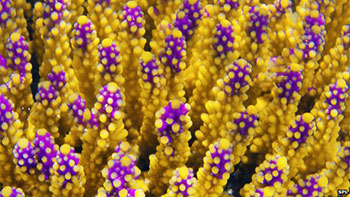
The world’s oceans are becoming acidic at an “unprecedented rate” and may be souring more rapidly than at any time in the past 300 million years.
In their strongest statement yet on this issue, scientists say acidification could increase by 170% by 2100.
They say that some 30% of ocean species are unlikely to survive in these conditions.
The researchers conclude that human emissions of CO2 are clearly to blame.
The study will be presented at global climate talks in Poland next week.
In 2012, over 500 of the world’s leading experts on ocean acidification gathered in California. Led by the International Biosphere-Geosphere Programme, a review of the state of the science has now been published.
This Summary for Policymakers states with “very high confidence” that increasing acidification is caused by human activities which are adding 24 million tonnes of CO2 to oceans every day.
Pickled waters
The addition of so much carbon has altered the chemistry of the waters.
Since the start of the industrial revolution, the waters have become 26% more acidic.
“This is the state of the art,” said Prof Jean-Pierre Gattuso, from CNRS, the French national research agency.
“My colleagues have not found in the geological record, rates of change that are faster than the ones we see today.”
What worries the scientists is the potential impact on many ocean species including corals
.Studies carried out at deep sea vents where the waters are naturally acidic thanks to CO2, indicate that around 30% of the ocean’s biodiversity may be lost by the end of this century.
These vents may be a “window on the future” according to the researchers.
Continue reading the main story
“You don’t find a mollusc at the pH level expected for 2100, this is really quite a stunning fact,” said Prof Gattuso.
“It’s an imperfect window, only the ocean’s acidity is increasing at these sites, they don’t reflect the warming we will see this century.
“If you combine the two, it could be even more dramatic than what we see at CO2 vents.”
The effect of acidity is currently being felt most profoundly felt in the Arctic and Antarctic oceans. These chilly waters hold more CO2 and increasing levels of the gas are turning them acidic more rapidly than the rest of the world.
The more acidic they become, the more damaging they are to the shells and skeletons of marine organisms.
The researchers say that by 2020, ten percent of the Arctic will be inhospitable to species that build their shells from calcium carbonate. By 2100 the entire Arctic will be a hostile environment.
Sea snail Pteropods like this are already feeling the corrosive impact of acidic waters in the Antarctic
These effects are already visible says Prof Gattuso.
“In the Southern Ocean, we already see corrosion of pteropods which are like sea snails, in the ocean we see corrosion of the shell.
“They are a key component in the food chain, they are eaten by fish, birds and whales, so if one element is going then there is a cascading impact on the whole food chain.”
The authors warn that the economic impact of the losses from aquaculture could be huge – the global cost of the decline in molluscs could be $130bn by 2100 if emissions of CO2 continue on their current pathway.
Adding alkaline substances such as crushed limestone to the waters has been mooted as a potential way of mitigating the worst impacts of acidification. But Prof Gattuso says it would only have a limited effect.
“Maybe in bays which have a restricted exchange with open oceans it may work, it may give some local relief.
“But the latest research is showing that it is not really practical at a global scale. It is very expensive and very energy intensive.”
Marine protection zones would also give some short term benefit, but the scientists say that in the long term only significant cuts in emissions will slow the progress of acidification.
By Matt McGrath Environment correspondent, BBC News.
H.SH