
Syrian hand-woven carpet industry
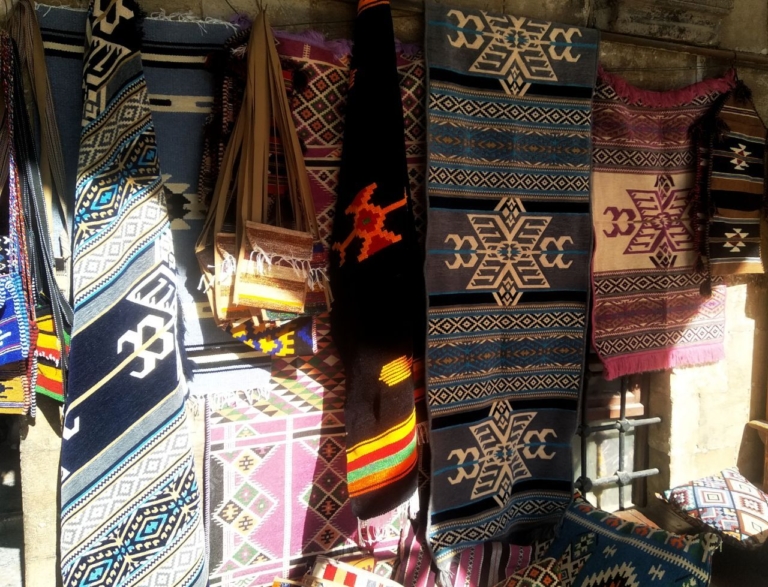
The history of the carpet industry is very old as it is believed that the first carpet was woven 500 years before BC, and that the first home of this handicraft is the Eurasian Steppe and Central Asia.
This industry dates back to 7 centuries ago in Syria, according to the owner of a shop in Bab Sharqi area in Damascus, who indicated that Damascus was known for thousands of years for its “Damasco” fabric which was used for producing the most beautiful types of carpets woven from luxurious silk and embroidered with the most beautiful inscriptions and traditional and local drawings.
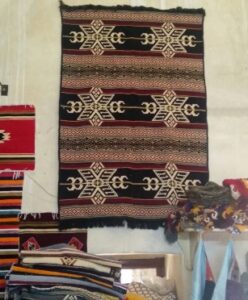 “In the fourteenth century, the carpet industry became famous at international level under the name “Damascene carpet” or “Mamluki carpet” because it was distinguished by its crimson red, golden yellow and navy blue colors and geometric patterns,” the owner of the shop told Syria Times anonymously.
He went on to say: “After World War I, the Armenians made carpets in Aleppo, and they used wool, cotton and silk as raw materials…..This handicraft was passed on to the children from their forefathers until the middle of the last century when many workers began to abandon this craft due to the emergence of machine- made carpets… So, in the mid of sixties of the last century, the Syrian government established what was called “Units for Teaching Handmade Carpet Industry”, and they were spread mainly in the rural areas and small cities, and their number reached more than hundred units at the end of the last century.”
“The carpet industry continued to develop, and many factors contributed to changing it despite the spread of machine-made carpets… The traditional industry preserved its most important characteristics, and continued to produce good products that contain the most beautiful shapes using the most wonderful colors; therefore, many consider carpets as pieces of art.”
The handmade carpet industry was famous in Damascus, Aleppo, Hama, Idlib and Latakia.
The craftsman Imad Wardeh is the only one who is still making handmade carpets in Damascus for those who are interested in heritage and order small carpets due to its sky high prices.
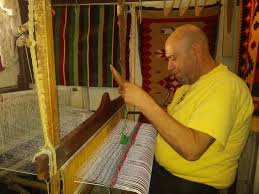 “ I loved this craft since my childhood when my father used to take me and my brother to the workshop, and we started to practice it when we were 15 years old. Today, I am more than 50 years old and I have passed this craft to my two children and my wife, who work with me… One of us spins the wool, another dyes it, a third winds the thread on pipes, and then a fourth sews it on the handloom. It’s a whole family business,” the craftsman said.
He made it clear that the raw materials used in this craft exist in Syria and this is the secret behind the success and the continuity of this craft. “ It is an industry linked to the Syrian environment, as cotton is grown in Raqqa and the countryside of Hama, wool is taken from goats and sheep in the Syrian desert, and silk is from Masyaf, but the latter (silk industry) is currently faltering.”
“As for the dyes, there are vegetable dyes that are distinguished by their beauty and stability over time, and they depend on extracts from the flowers of the “indigo” plant to obtain the blue color, and the leaves of the vine and almonds to obtain the yellow color, and the roots of the madder plant to obtain the red color, and there are dyes made from chemicals which are currently popular,” Mr. Wardeh added.
He went on to say: “The loom is the only machine in our industry…The “hand loom” dates back to more than 5 centuries ago…It is rooted in the history of our region. It is said that the loom existed 3000 years BC. It is the same one that was used in the Kingdom of Ebla and the Kingdom of Mari where they were knitting silk for kings and wool and cotton for the common people. This simple loom was used to make clothing and brushes. Our presence on the Silk Road, helped in the promotion of this industry in our region. One of the advantages of the handloom is that it makes a product full of life, because the one who accomplishes it is the artist, not the machine.”
This craft is characterized by simplicity since it relies on the loom as the only machine in the work, while the rest of the work is completely manual, according to Mr. Wardeh.
“It takes a week- and sometimes more than that- to sew a pattern on a piece. When the patterns are varied, we need a long time to do it, thus its price is high,” he said.
He trained many people, but the problem is that his loom is unique, and the remaining looms in the country are few, and the workers who were practicing this craft left because of the crisis in our country.
Because of the high prices of our products, the craftsman resorted to the remains of fabrics as a raw material to produce pieces at relatively reasonable prices in the local market.
“Our products have become a kind of decoration, and the demand for them has returned through the Syrian expatriates who are interested in the heritage of their country, so they return to buy pieces of our products, which slightly compensates for the lack of foreign tourists who used to buy them in the past. We also sell our products in the Gulf countries who like to have our unique pieces of art to decorate their houses,” he concluded.
Reported by : Basma Qaddour