
The last family working in glass blowing in Damascus struggles to keep the craft alive
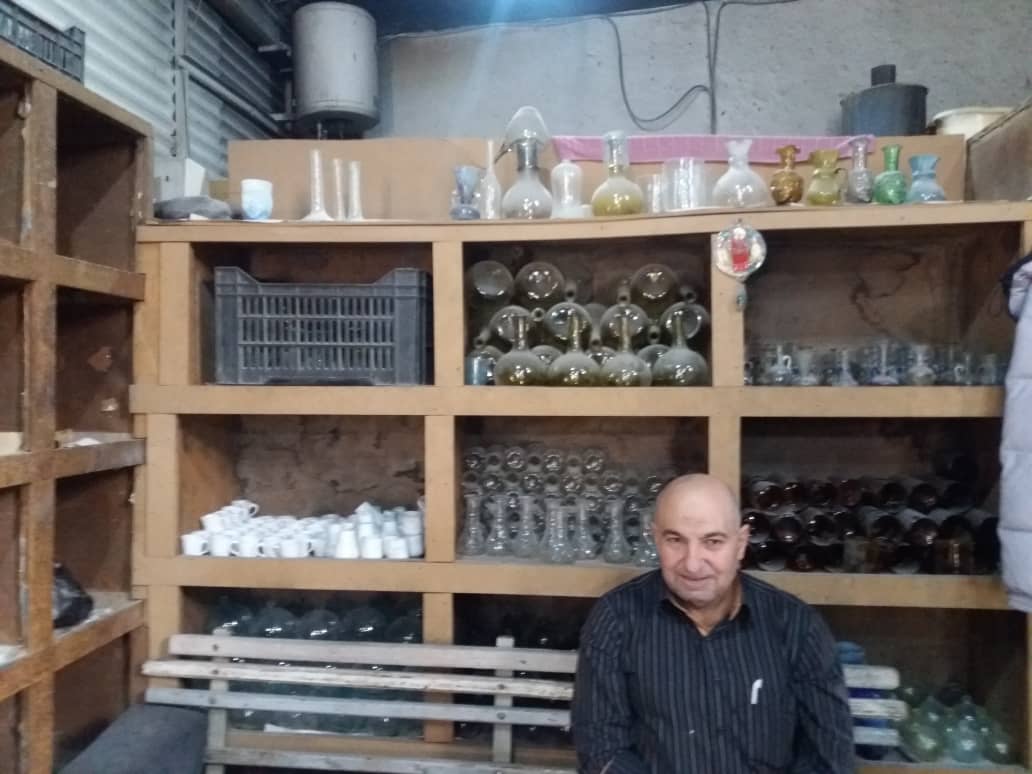
Inside his family’s modest factory in Bab Sharqi neighborhood in Damascus, the glass blower Mr.Ahmad Al-Hallak was sitting in front of a lot of hand-made glass pieces put on shelves and near his small furnace, which was off because of the shortage of diesel.This was how he received me after I had entered from the door of his factory to conduct an interview with him .
“ The furnace is off due to the shortage of diesel and workers… It needs 180 liters of diesel daily and it is difficult to ensure such a quantity nowadays,” he said in a sorrowful tone.
He has not blown through the long metal tube into billowing red-hot glass since 4 months ago. Moreover, his factory had closed for 7 years when the crisis started in the country in 2011.
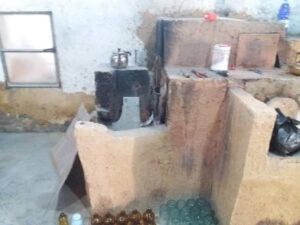
“Nowadays, we can not accept orders because we can not abide by the date of delivering it as a result of the shortage of diesel. I accepted one order last year and I could not deliver it up till now,” the 66-year- old man said.
He clarified that the government sells few quantity to industrialist at 3000-3200 Syrian pounds/ one liter , while its price on the black market is 12000-13000 Syrian pounds/ one liter.
“Buying diesel from the black market necessitates increasing the prices …Hardly anyone buys handmade glass anymore,” Mr. Al-Hallak added.
He went on the say: “We can not change the mechanism of our craft. The only thing that we can do is to enlarge the furnace for producing more quantity of glasses . But this is impossible now due to 2 main reasons: there isn’t enough quantity of diesel to operate the furnace and there is no one working in this profession except me and my brother.
Abo Mahmod explained to us the mechanism of his work.
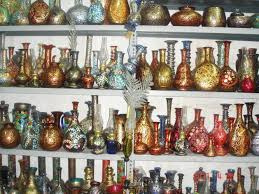
“Firstly, we classify the broken glass that we get from the shops and factories upon colours and then we put it in the furnace at 1200 degree, take it out, blow into the molten glass, shape it up, and decorate it…. The worker can produce 70 pieces of classes daily.”
His factory was exporting products to European countries.
“The exportation of glass product has been affected by COVID pandemic and the Russian-Ukrainian conflict since the priorities in the EU countries have changed and have focused on ensuring food, medicine, power…etc” Abo Mahmod said.
Some shops in France have taken glasses from my factory and they put flowers or wax inside them to sell them to customers.
Regarding the selling in the local market, he indicated that the Minister of Tourism issued a law on obligating all tourist projects, whether they are invested locally or internationally, to buy 60% of their equipment from local market and this has enhanced the work of various types of crafts.
Mr. Al-Hallak learnt the skill of glass production from his forefathers.
“There were 15 factories for making glasses in Al-Shagour area in Damascus, and my father was working in one of these factories…I was 7 years old then and I was going with my father to the factory there. Four years later, my father moved to this factory in which we are now and I started to work with him…. I love this craft,” he said.
“We have a small mobile furnace that we use to take part in exhibitions being held in the country on several occasions to make people familiar with this craft….. When I went to Iran to take part in an exhibition there in 2011, I was invited to visit a glass factory there and I showed them how we work,” the master of the craft in Syria declared.
He passed on the trade to his own children, but they do not practice it.
“My children do not want to practice it as it’s not financially viable and it requires working for a long time ,” he said, indicating that person needs at least 5 years to train on glass blowing.
The craft of producing glasses manually exist only in Syria; however Italy have managed to convey this craft to it and developed it.
“Around 30 years ago,an Italian professor and his assistant came to our factory and they brought their materials with them. We cooperated with them and the result was that we Syrian can use their furnaces to make glasses but they can not use ours,” Mr. Al-Hallak said.
Asked about the prices of glass product, the craftsman said: “ The price of small glass vasa he made one year ago is 7000 Syrian Pounds, and it will cost 15000 Syrian pounds, if he want to produce it today.”
Phoenicians are believed to have invented this craft more than 2,000 years ago.
Interviewed by: Basma Qaddour