
Al-Oud is a Part of The Memory and Identity of Syrian Art
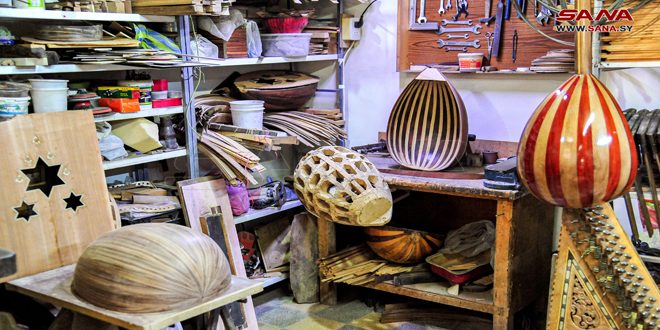
Oud is considered to be “the king of Eastern instruments” and the title of authentic rapture. It recounts with its strings, the stories of Syrian art and the creations of this land’s sons who consider it an essential part of their intangible cultural heritage inherited from their ancestors, and who work to develop their knowledge and skills related to it.
The quality of the oud is first measured by the quality of the wood and ends with the tune. It is assumed that the name al-oud is derived from the Arabic for (the wood). Its industry requires skill and precision from the chord to the peg, where it is made from walnut wood for its adaptability, graded colors and sound.
Artisans use symbols inspired by their ancestral life and culture in decorating and designing the Oud. This instrument continues to have a distinctive presence on many social and cultural occasions, and its music has been able to move from generation to generation and evolve without giving up its authenticity as a key element of groups’ and individuals’ intangible cultural heritage and preservation of a large part of their memory and cultural identity.
To learn the history of Oud in Old Age, the expert on the maintenance of stringed instruments at the Higher Institute of Music, the researcher in ancient oriental instruments, Issa Michel Awad, noted that the earliest appearance of the oud instrument dates back to the Akkadian era about 3000 years BC in the Mesopotamian region as archaeologists have confirmed through archaeological discoveries and murals. Egypt first used it in the modern kingdom in 1500 BC. In Syria, Al-Oud appeared in the 15 century B.C., while it spread in Palestine, the Arabian Peninsula and Greece in the fourth century B.C., it was then known in all Arab countries.
Awad talked about the influence of the famous musician Ziryab on the Oud in the Abbasid era, who worked to reduce the weight of the instrument. As for the strings of the Oud at Ziryab were three strings, and thereafter his student Isaac al-Mawsili had a role in adding a fourth string to the oud and gave each string a name, including “zeer, bam, and tack.” The strings made of animal intestines were colored as a kind of nature, and the chest was made of leather, but because it was affected by weather conditions, it turned into wood, noting that the feather was of a hard wood, and had harmful effect on the strings to be replaced later by the eagle’s feather. Today it is made of different polished materials to adapt to the teacher, student or player.
Awad indicated that the Oud used to accompany the human sound, oriental takht, and evening parties, but today it has various schools of “Damascene, Egyptian, Gulf, and others,” indicating that in modern schools the instrument was developed, as the musician Fareed Al-Atrash added a string, so there was a performance of music in its widest scope, and it was no longer confined to a singer or an oriental takht. Rather, it has spread to present compositions related to the oud in dialogues that may be done with the piano and the orchestra, indicating that, depending on the composer’s or the player’s need, additional strings are added.
According to Awad, one of Syria’s best-known old makers is the Damascene Nahhat family, who have reached a full stage of creativity by making the instrument. It is known that before 1900 the measurements of the oud were irregular so that the work of this family’s sons and grandsons was characterized by accuracy, durability, quality and regularity of measurements, as well as the aesthetic aspect of the Oud.
They introduced the mosaic craft to the oud, using the natural colors of wood in manufacturing the Oud such as nut, cypress, apricot and rose, not to mention their artistry with the sound-hole that was characterized by infinite accuracy.
Awad reviewed the most famous Oud makers in Syria, throughout its ancient, middle, and modern history, referring to Jamil Kandalaft of Aleppo, who made an Oud from the shells, and gifted it to Farid al-Atrash, and Na’im Jurji Dalal, whose oud was distinguished by sound-holes , pointing out that the oud maker was not proficient in playing it, but Today, they have become professional musicians, who are also skilled Oud makers, which has made the development clear and mastered by the fact that (the manufacturer musician) is better able to figure out and avoid mistakes.
Oud is one of those few musical instruments, which has not lost its inherent qualities despite the changes of time and tradition.
Amal Farhat